Today in Space
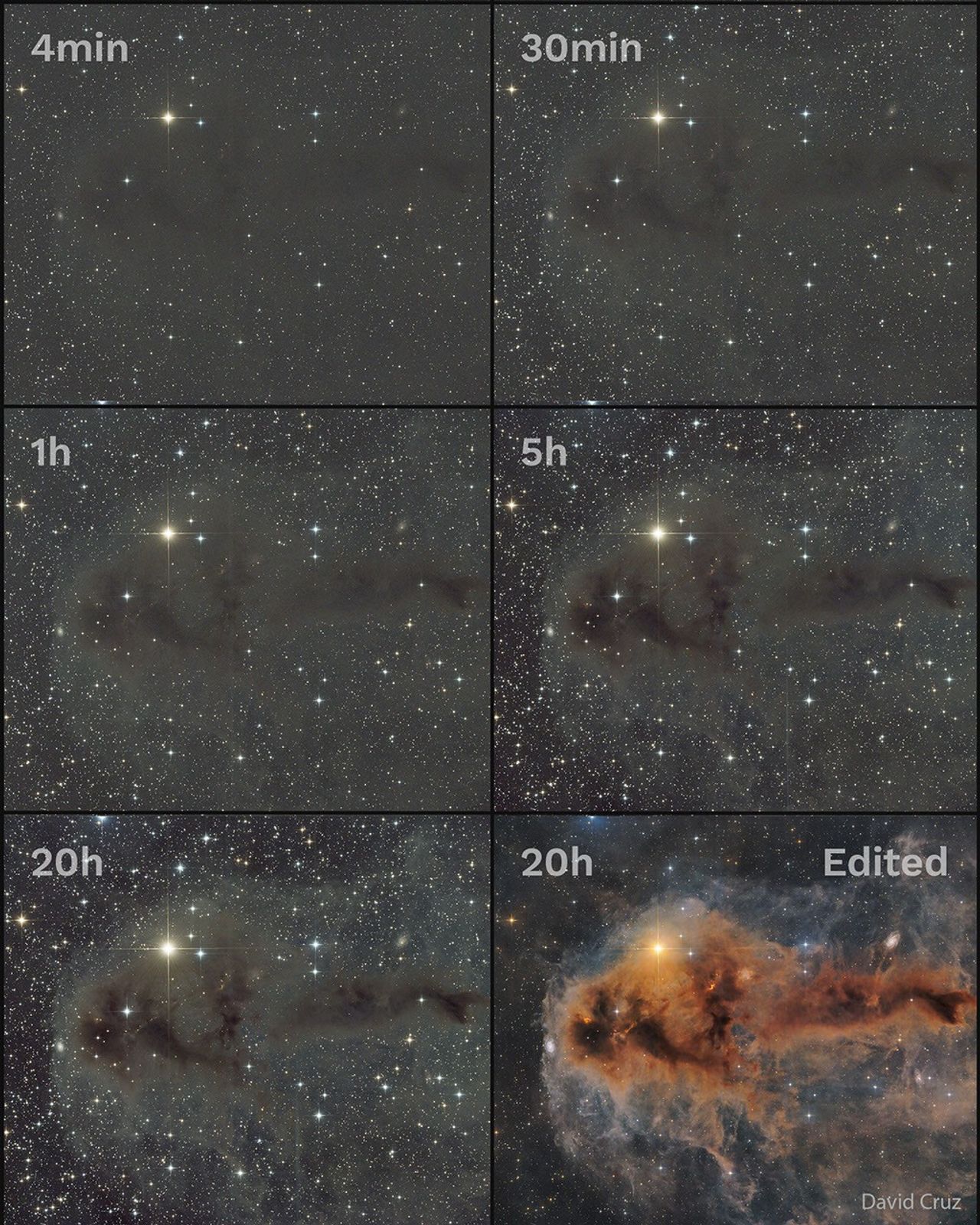
The Emergence of Dark Nebula Lynds 1251
Explanation: If you stare into space for a long time, what might you see? At first, you might only see the usual brightest stars, but if your eyes (or camera) could continue to collect light, you would see increasingly more. In the direction of the featured image, after only a few minutes, you would begin to notice some regions without stars. As your staring continued, the dark region would become better defined, and after a full 20 hours, you would notice a strange dark structure. To celebrate, you use digital processing to brighten the image and enhance the colors. At the end, you might have an excellent image of Lynds 1251 (LDN 1251), a star-forming region laced with opaque brown-appearing interstellar dust. Also known as the Rotten Fish Nebula, LDN 1251 is home not only to young stars and dust, but also, your long staring indicates, energetic shock waves, fast stellar winds, and powerfully beamed jets. Tomorrow's picture: galaxies ringing
Credit & Copyright: David Cruz
A 0–9 score for how stirred up Earth’s magnetic field is, measured every 3 hours by magnetometers around the world. 0–2 is quiet, 3–4 is unsettled, and 5 or more is a geomagnetic storm. The higher it goes, the farther from the poles the northern lights reach. Around Kp 5, people in Washington State can sometimes see them low in the north.
- Kp 5 G1 minor
- Kp 6 G2 moderate
- Kp 7 G3 strong
- Kp 8 G4 severe
- Kp 9 G5 extreme
A rough guide based only on the current Kp: Unlikely below 4, Possible at 4–5, Likely at 6–7, Strong at 8+. It isn’t for your exact location, so use “Your sky this week” for odds where you are. Clouds and city lights matter too.
Learn more at NOAA SWPCA stream of charged particles flowing from the Sun, measured by spacecraft about 1.5 million km (1 million miles) toward the Sun from Earth. It usually blows at 300–500 km/s. Faster than about 600 km/s often means stormier space weather, and whatever is measured now reaches Earth roughly 30–60 minutes later.
Learn more at NOAA SWPCNOAA’s forecast of the highest Kp expected each day. It’s a forecast, so big storms can arrive earlier or later than predicted.
Learn more at NOAA SWPCEnter a zip code or use your location to see when the ISS, Tiangong and Hubble will be visible from where you are over the next 7 days, plus the planets and Moon tonight.
A 0–9 score for how stirred up Earth’s magnetic field is, measured every 3 hours by magnetometers around the world. 0–2 is quiet, 3–4 is unsettled, and 5 or more is a geomagnetic storm. The higher it goes, the farther from the poles the northern lights reach. Around Kp 5, people in Washington State can sometimes see them low in the north.
- Kp 5 G1 minor
- Kp 6 G2 moderate
- Kp 7 G3 strong
- Kp 8 G4 severe
- Kp 9 G5 extreme
Times in your time zone. Predictions can shift by a minute or two as orbits change.
Launches this year
Loading 3D globe…
Positions are computed live in your browser with SGP4, the standard model NORAD and NASA trackers use, from the latest public orbital elements. Typical error is a few kilometers, smaller than the dot at this zoom.
Learn more at CelesTrakCheck it: NASA Spot the Station · Watch the ISS live from orbit
Positions of the ISS, Hubble and Tiangong are calculated live in your browser from each one’s latest orbital elements (CelesTrak), at true altitude. Aurora forecast from NOAA’s OVATION model, valid around —. Earth imagery: NASA Blue Marble; city lights: NASA Earth Observatory / Black Marble. Satellite positions: CelesTrak.