Past Forecasts
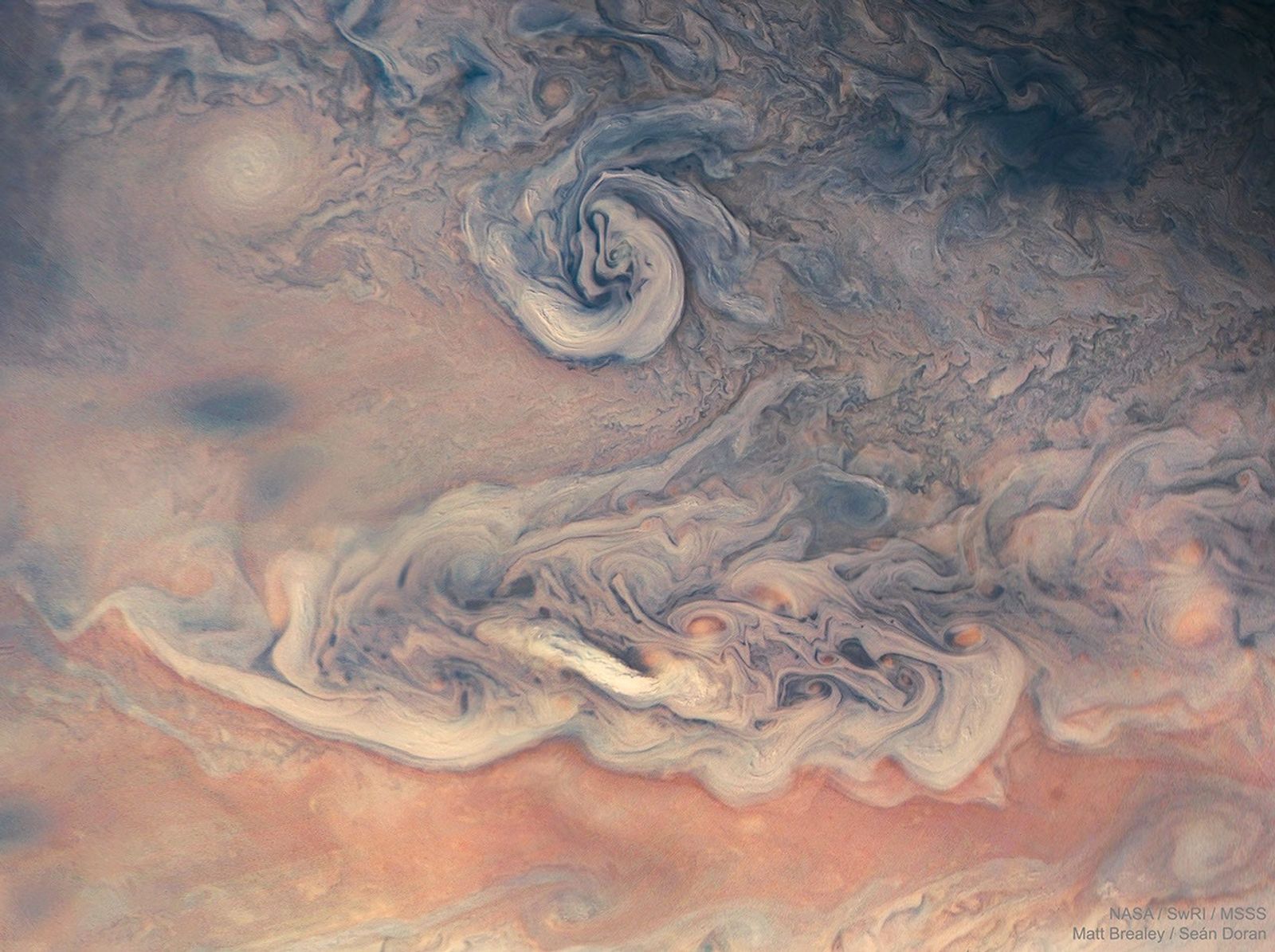
Swirls and Colors on Jupiter from Juno
Explanation: What creates the colors in Jupiter's clouds? No one is sure. The thick atmosphere of Jupiter is mostly hydrogen and helium, elements which are colorless at the low temperatures of the Jovian cloud tops. Which trace molecules provide the colors remains a topic of research, although small amounts of ammonium hydrosulfide are one leading candidate. What is clear from the featured color-enhanced image -- and many similar images -- is that lighter clouds are typically higher up than darker ones. Pictured, light clouds swirl around reddish regions toward the lower right, while they appear to cover over some darker domains on the upper right. The featured image was taken by the robotic Juno spacecraft in 2018 during its 14th low pass over Jupiter. Juno continues in its looping elliptical orbit, swooping near the huge planet every 33 days and exploring a slightly different sector each time around. Tomorrow's picture: emerging darkness
Credit & Copyright: NASA, Juno, SwRI, MSSS; Processing & License: Matt Brealey, Seán Doran
A 0–9 score for how stirred up Earth’s magnetic field is, measured every 3 hours by magnetometers around the world. 0–2 is quiet, 3–4 is unsettled, and 5 or more is a geomagnetic storm. The higher it goes, the farther from the poles the northern lights reach. Around Kp 5, people in Washington State can sometimes see them low in the north.
- Kp 5 G1 minor
- Kp 6 G2 moderate
- Kp 7 G3 strong
- Kp 8 G4 severe
- Kp 9 G5 extreme
A rough guide based only on the current Kp: Unlikely below 4, Possible at 4–5, Likely at 6–7, Strong at 8+. It isn’t for your exact location, so use “Your sky this week” for odds where you are. Clouds and city lights matter too.
Learn more at NOAA SWPCA stream of charged particles flowing from the Sun, measured by spacecraft about 1.5 million km (1 million miles) toward the Sun from Earth. It usually blows at 300–500 km/s. Faster than about 600 km/s often means stormier space weather, and whatever is measured now reaches Earth roughly 30–60 minutes later.
Learn more at NOAA SWPCISS · 7
-
 Anil Menon
NASA
-
 Anna Kikina
Roscosmos
-
Jessica Watkins
NASA
-
 Joshua Kutryk
CSA
-
Luke Delaney
NASA
-
Pyotr Dubrov
Roscosmos
-
Sergey Teteryatnikov
Roscosmos
Tiangong · 3
-
 Lai Ka-ying
CNSA
-
Zhang Zhiyuan
CNSA
-
Zhu Yangzhu
CNSA