Past Forecasts
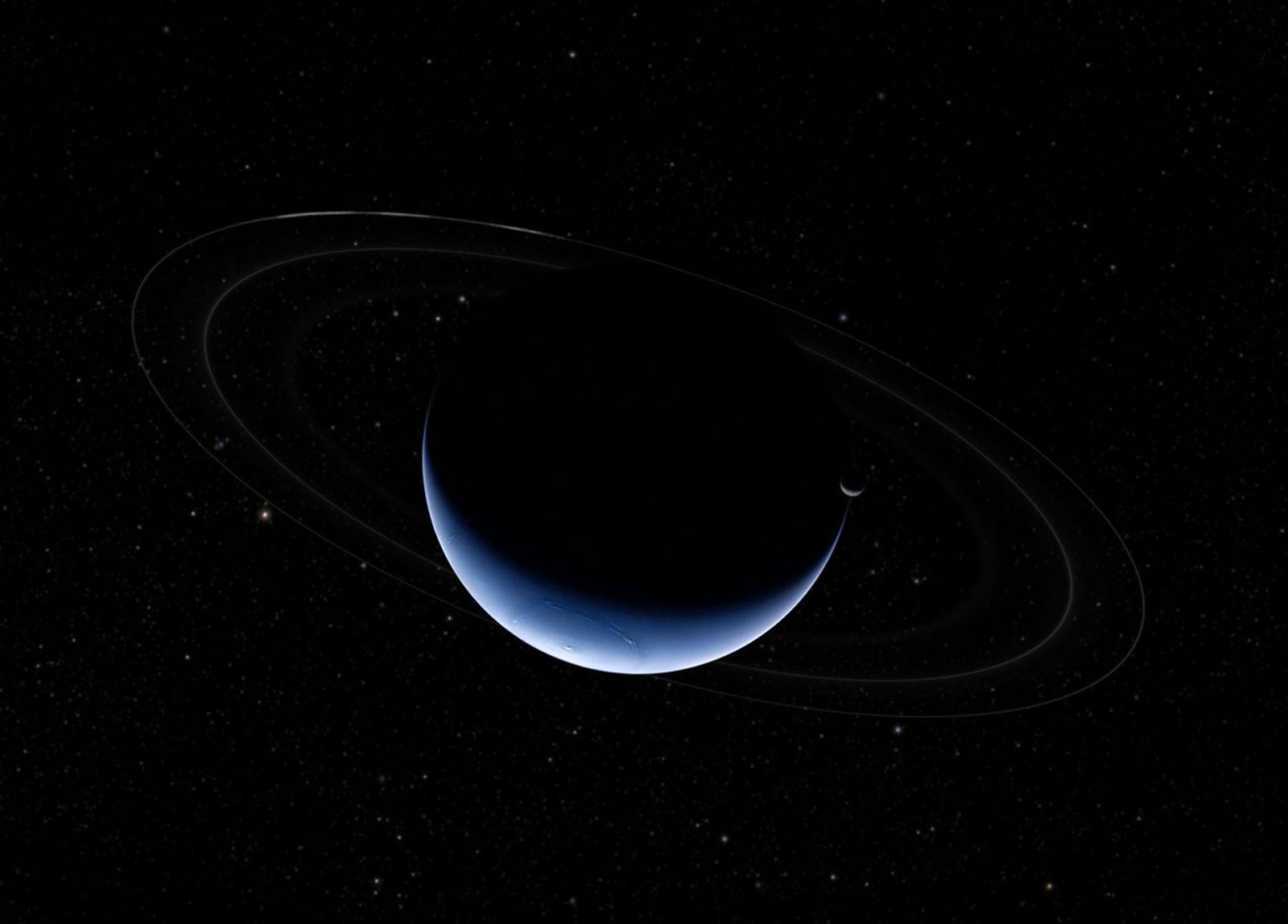
Voyager's Neptune
Explanation: Cruising through the outer solar system, the Voyager 2 spacecraft made its closest approach to Neptune on August 25, 1989, the only spacecraft to visit the most distant ice giant planet. Based on the images recorded during its close encounter and in the following days, this inspired composited scene covers the dim outer planet, largest moon Triton, and faint system of rings. From just beyond Neptune's orbit, the interplanetary perspective looks back toward the Sun, capturing the planet and Triton as thin sunlit crescents. Cirrus clouds and a dark band circle Neptune's south polar region, with a cloudy vortex above the pole itself. Parts of the very faint ring system along with the three bright ring arcs were first imaged by Voyager during the fly-by, though the faintest segments are modeled in this composited picture. Spanning 7.5 degrees, the background starfield is composed from sky survey data centered on the constellation Camelopardalis, corresponding to the outbound Voyager's view of the magnificent Neptunian system. Still cruising in 2026, the Voyager 2 spacecraft is now in interstellar space. Tomorrow's picture: swirling
Credit & Copyright: Assembly/Processing - Rolf Olsen, Data - Voyager 2, NASA Planetary Data System
A 0–9 score for how stirred up Earth’s magnetic field is, measured every 3 hours by magnetometers around the world. 0–2 is quiet, 3–4 is unsettled, and 5 or more is a geomagnetic storm. The higher it goes, the farther from the poles the northern lights reach. Around Kp 5, people in Washington State can sometimes see them low in the north.
- Kp 5 G1 minor
- Kp 6 G2 moderate
- Kp 7 G3 strong
- Kp 8 G4 severe
- Kp 9 G5 extreme
A rough guide based only on the current Kp: Unlikely below 4, Possible at 4–5, Likely at 6–7, Strong at 8+. It isn’t for your exact location, so use “Your sky this week” for odds where you are. Clouds and city lights matter too.
Learn more at NOAA SWPCA stream of charged particles flowing from the Sun, measured by spacecraft about 1.5 million km (1 million miles) toward the Sun from Earth. It usually blows at 300–500 km/s. Faster than about 600 km/s often means stormier space weather, and whatever is measured now reaches Earth roughly 30–60 minutes later.
Learn more at NOAA SWPCISS · 7
-
 Anil Menon
NASA
-
 Anna Kikina
Roscosmos
-
Jessica Watkins
NASA
-
 Joshua Kutryk
CSA
-
Luke Delaney
NASA
-
Pyotr Dubrov
Roscosmos
-
Sergey Teteryatnikov
Roscosmos
Tiangong · 3
-
 Lai Ka-ying
CNSA
-
Zhang Zhiyuan
CNSA
-
Zhu Yangzhu
CNSA