Past Forecasts
V-G-R
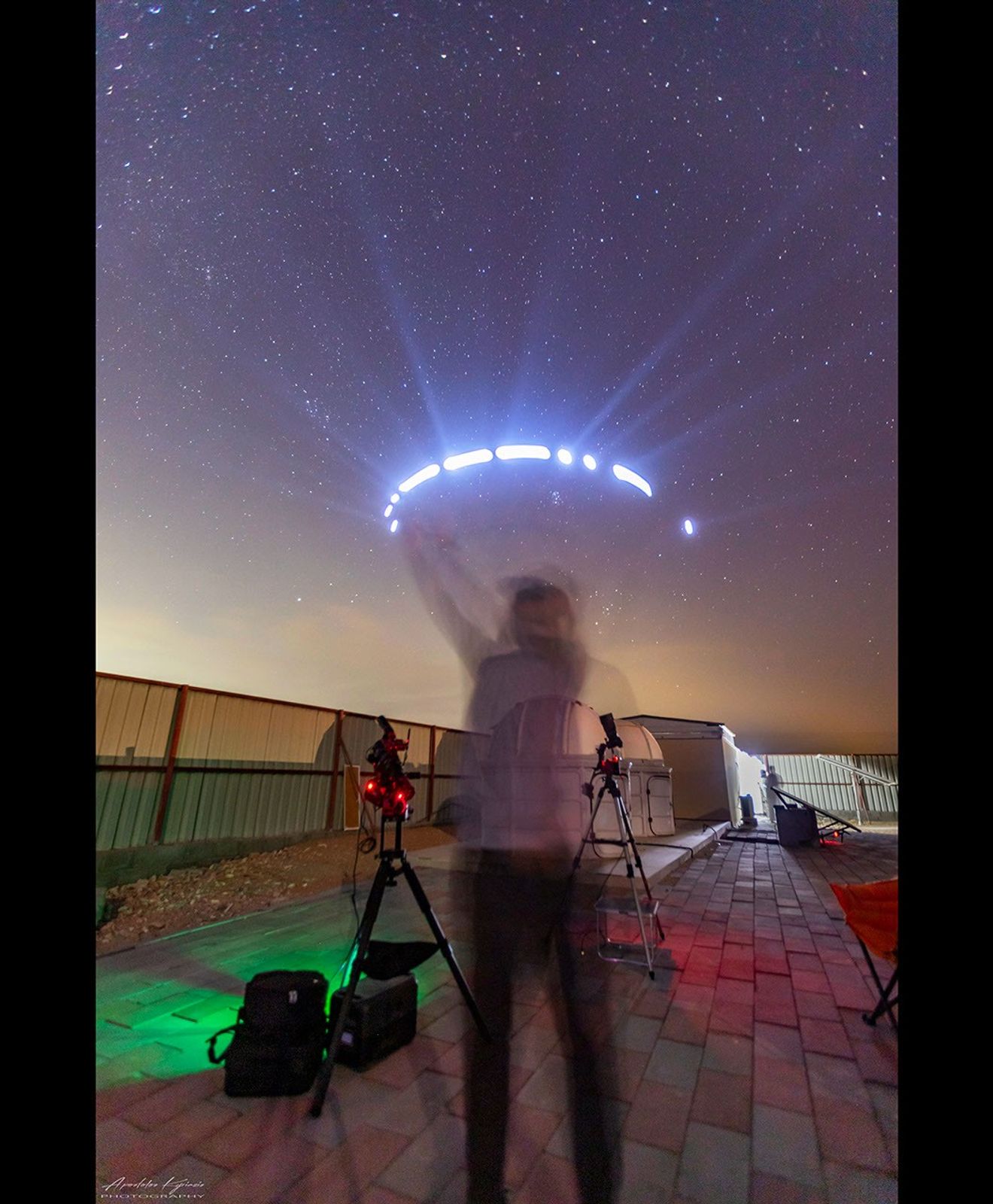
Explanation: On November 17, fans of interstellar spaceflight around planet Earth were invited to shine a message into the night sky. Traced by a flashlight beam switched on and off, the dashes and dots of a Morse code message captured in this time exposure from the Emirates Astronomical Observatory are read V-G-R. That's a call sign for the Voyager 1 spacecraft currently in interstellar space some 26 billion kilometers away. How long did it take the message to reach humanity's most distant interstellar spacecraft? Traveling at the speed of light, the answer is one day. In fact, the Voyager 1 spacecraft was confirmed to reach its one light-day distance milestone on November 18, at 10:16:07 UTC, nearly 50 years after launch in 1977. For extra credit, fans of math can calculate that at one light-day per 50 years, Voyager 1 will reach its one light-year (365 light-days) distance milestone in about 18,250 years. Tomorrow's picture: cruising
Credit & Copyright: Apostolos Kyriazis
A 0–9 score for how stirred up Earth’s magnetic field is, measured every 3 hours by magnetometers around the world. 0–2 is quiet, 3–4 is unsettled, and 5 or more is a geomagnetic storm. The higher it goes, the farther from the poles the northern lights reach. Around Kp 5, people in Washington State can sometimes see them low in the north.
- Kp 5 G1 minor
- Kp 6 G2 moderate
- Kp 7 G3 strong
- Kp 8 G4 severe
- Kp 9 G5 extreme
A rough guide based only on the current Kp: Unlikely below 4, Possible at 4–5, Likely at 6–7, Strong at 8+. It isn’t for your exact location, so use “Your sky this week” for odds where you are. Clouds and city lights matter too.
Learn more at NOAA SWPCA stream of charged particles flowing from the Sun, measured by spacecraft about 1.5 million km (1 million miles) toward the Sun from Earth. It usually blows at 300–500 km/s. Faster than about 600 km/s often means stormier space weather, and whatever is measured now reaches Earth roughly 30–60 minutes later.
Learn more at NOAA SWPCISS · 7
-
 Anil Menon
NASA
-
 Anna Kikina
Roscosmos
-
Jessica Watkins
NASA
-
 Joshua Kutryk
CSA
-
Luke Delaney
NASA
-
Pyotr Dubrov
Roscosmos
-
Sergey Teteryatnikov
Roscosmos
Tiangong · 3
-
 Lai Ka-ying
CNSA
-
Zhang Zhiyuan
CNSA
-
Zhu Yangzhu
CNSA