Past Forecasts
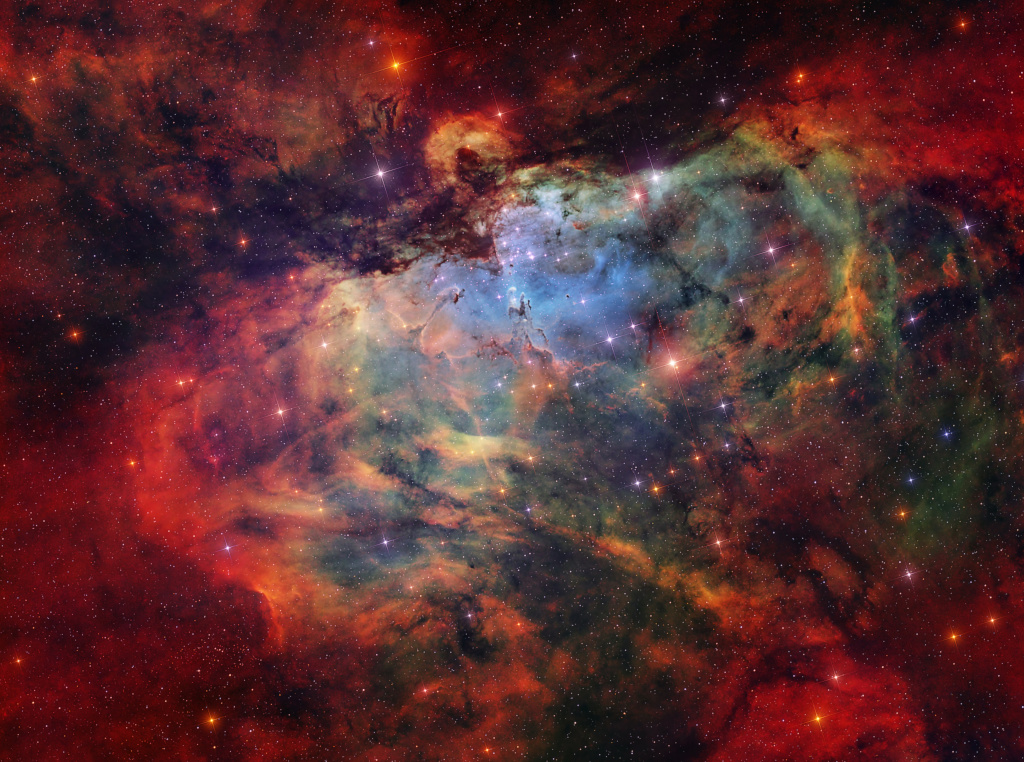
The Eagle Nebula and Friends
What looks as if it is going to swallow the great Pillars of Creation? The Eagle Nebula (M16) is not a bird, a plane, or Superman. M16 is actually a combination of several celestial objects. NGC 6611 is the young star cluster that appears to peak out beneath the Eagle’s “wings”. The ultraviolet light from these stars ionizes the surrounding gas, creating the emission nebula IC 4703. The Stellar Spire is seen reaching towards the Pillars of Creation from the left. Both are structures of cold gas and dust that are optimal for star formation. Some astronomers previously thought the Pillars of Creation had been evaporated away by a supernova. Because M16 is 6,000 light years away, we would not be able to see the Pillars’ destruction for thousands more years. However, there is no conclusive evidence of the theorized supernova, so the Pillars of Creation will likely continue to create stars for millions of years.
Credit & Copyright: Emmanuel Delgadillo Text: Keighley Rockcliffe (NASA GSFC, UMBC CSST, CRESST II)
A 0–9 score for how stirred up Earth’s magnetic field is, measured every 3 hours by magnetometers around the world. 0–2 is quiet, 3–4 is unsettled, and 5 or more is a geomagnetic storm. The higher it goes, the farther from the poles the northern lights reach. Around Kp 5, people in Washington State can sometimes see them low in the north.
- Kp 5 G1 minor
- Kp 6 G2 moderate
- Kp 7 G3 strong
- Kp 8 G4 severe
- Kp 9 G5 extreme
A rough guide based only on the current Kp: Unlikely below 4, Possible at 4–5, Likely at 6–7, Strong at 8+. It isn’t for your exact location, so use “Your sky this week” for odds where you are. Clouds and city lights matter too.
Learn more at NOAA SWPCA stream of charged particles flowing from the Sun, measured by spacecraft about 1.5 million km (1 million miles) toward the Sun from Earth. It usually blows at 300–500 km/s. Faster than about 600 km/s often means stormier space weather, and whatever is measured now reaches Earth roughly 30–60 minutes later.
Learn more at NOAA SWPC