Past Forecasts
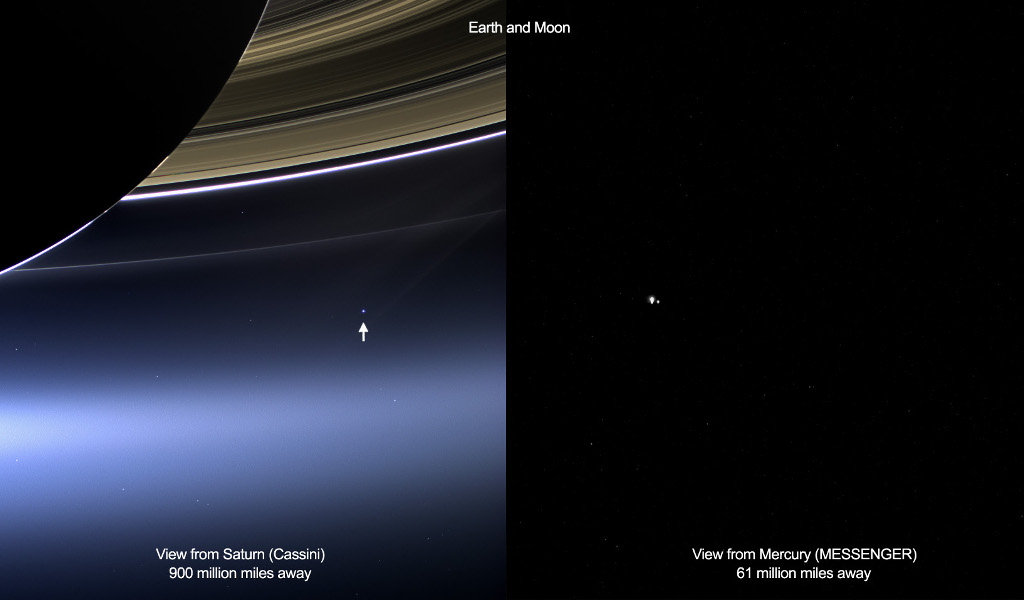
Interplanetary Earth
In an interplanetary first, on July 19, 2013 Earth was photographed on the same day from two other worlds of the Solar System, innermost planet Mercury and ringed gas giant Saturn. Pictured on the left, Earth is the pale blue dot just below the rings of Saturn, as captured by the robotic Cassini spacecraft then orbiting the outermost gas giant. On that same day people across planet Earth snapped many of their own pictures of Saturn. On the right, the Earth-Moon system is seen against the dark background of space as captured by the sunward MESSENGER spacecraft, then in Mercury orbit. MESSENGER took its image as part of a search for small natural satellites of Mercury, moons that would be expected to be quite dim. In the MESSENGER image, the brighter Earth and Moon are both overexposed and shine brightly with reflected sunlight. Destined not to return to their home world, both Cassini and MESSENGER have since retired from their missions of Solar System exploration.
A 0–9 score for how stirred up Earth’s magnetic field is, measured every 3 hours by magnetometers around the world. 0–2 is quiet, 3–4 is unsettled, and 5 or more is a geomagnetic storm. The higher it goes, the farther from the poles the northern lights reach. Around Kp 5, people in Washington State can sometimes see them low in the north.
- Kp 5 G1 minor
- Kp 6 G2 moderate
- Kp 7 G3 strong
- Kp 8 G4 severe
- Kp 9 G5 extreme
A rough guide based only on the current Kp: Unlikely below 4, Possible at 4–5, Likely at 6–7, Strong at 8+. It isn’t for your exact location, so use “Your sky this week” for odds where you are. Clouds and city lights matter too.
Learn more at NOAA SWPCA stream of charged particles flowing from the Sun, measured by spacecraft about 1.5 million km (1 million miles) toward the Sun from Earth. It usually blows at 300–500 km/s. Faster than about 600 km/s often means stormier space weather, and whatever is measured now reaches Earth roughly 30–60 minutes later.
Learn more at NOAA SWPC