Past Forecasts
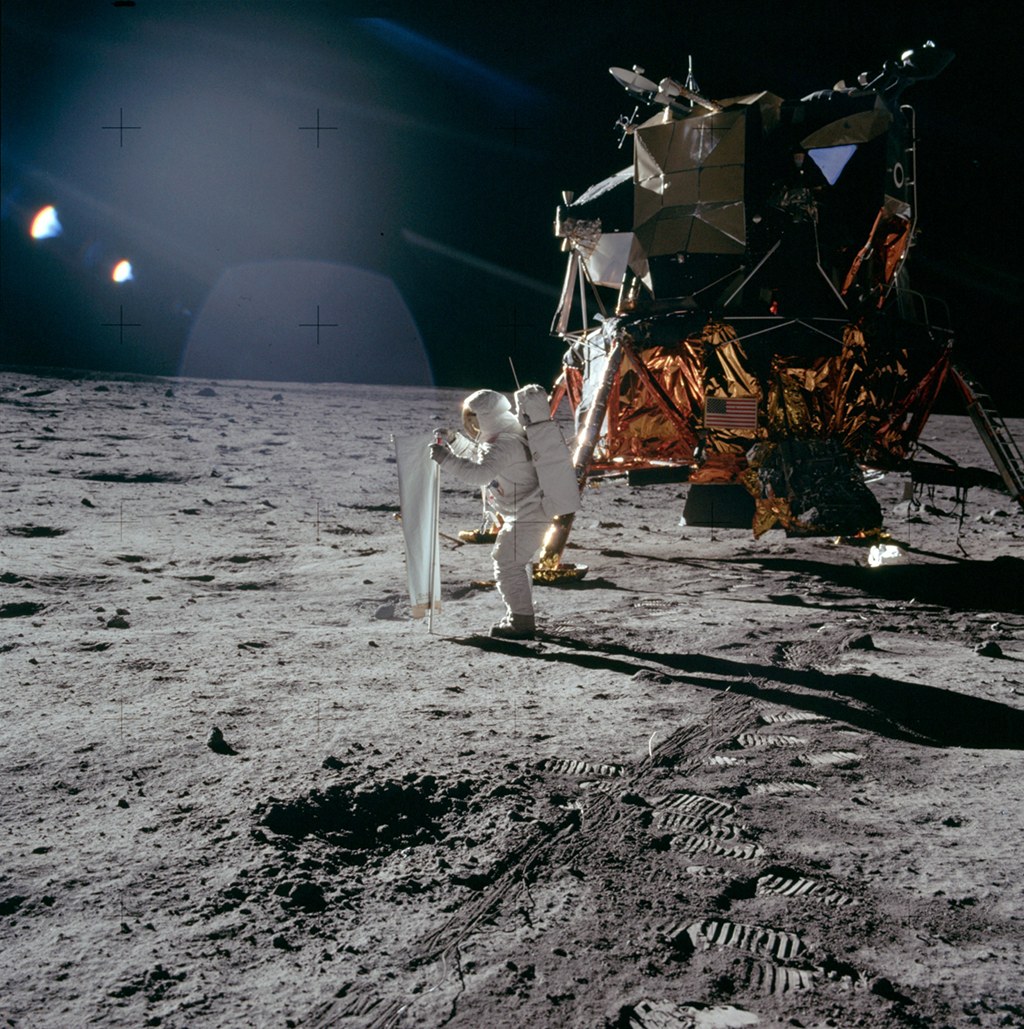
Apollo 11: Catching Some Sun
Bright sunlight glints as long dark shadows mark this image of the surface of the Moon. It was taken on July 20, 1969, by Apollo 11 astronaut Neil Armstrong, the first to walk on the lunar surface. Pictured is the mission's lunar module, the Eagle, and spacesuited lunar module pilot Buzz Aldrin. Aldrin is unfurling a long sheet of foil also known as the Solar Wind Composition Experiment. Exposed facing the Sun, the foil trapped particles streaming outward in the solar wind, catching a sample of material from the Sun itself. Along with 22 kilograms of moon rocks and lunar soil samples, the solar wind collector was returned for analysis in earthbound laboratories. APOD's main NASA site is moving: From apod.nasa.gov to science.nasa.gov/apod
A 0–9 score for how stirred up Earth’s magnetic field is, measured every 3 hours by magnetometers around the world. 0–2 is quiet, 3–4 is unsettled, and 5 or more is a geomagnetic storm. The higher it goes, the farther from the poles the northern lights reach. Around Kp 5, people in Washington State can sometimes see them low in the north.
- Kp 5 G1 minor
- Kp 6 G2 moderate
- Kp 7 G3 strong
- Kp 8 G4 severe
- Kp 9 G5 extreme
A rough guide based only on the current Kp: Unlikely below 4, Possible at 4–5, Likely at 6–7, Strong at 8+. It isn’t for your exact location, so use “Your sky this week” for odds where you are. Clouds and city lights matter too.
Learn more at NOAA SWPCA stream of charged particles flowing from the Sun, measured by spacecraft about 1.5 million km (1 million miles) toward the Sun from Earth. It usually blows at 300–500 km/s. Faster than about 600 km/s often means stormier space weather, and whatever is measured now reaches Earth roughly 30–60 minutes later.
Learn more at NOAA SWPC