Past Forecasts
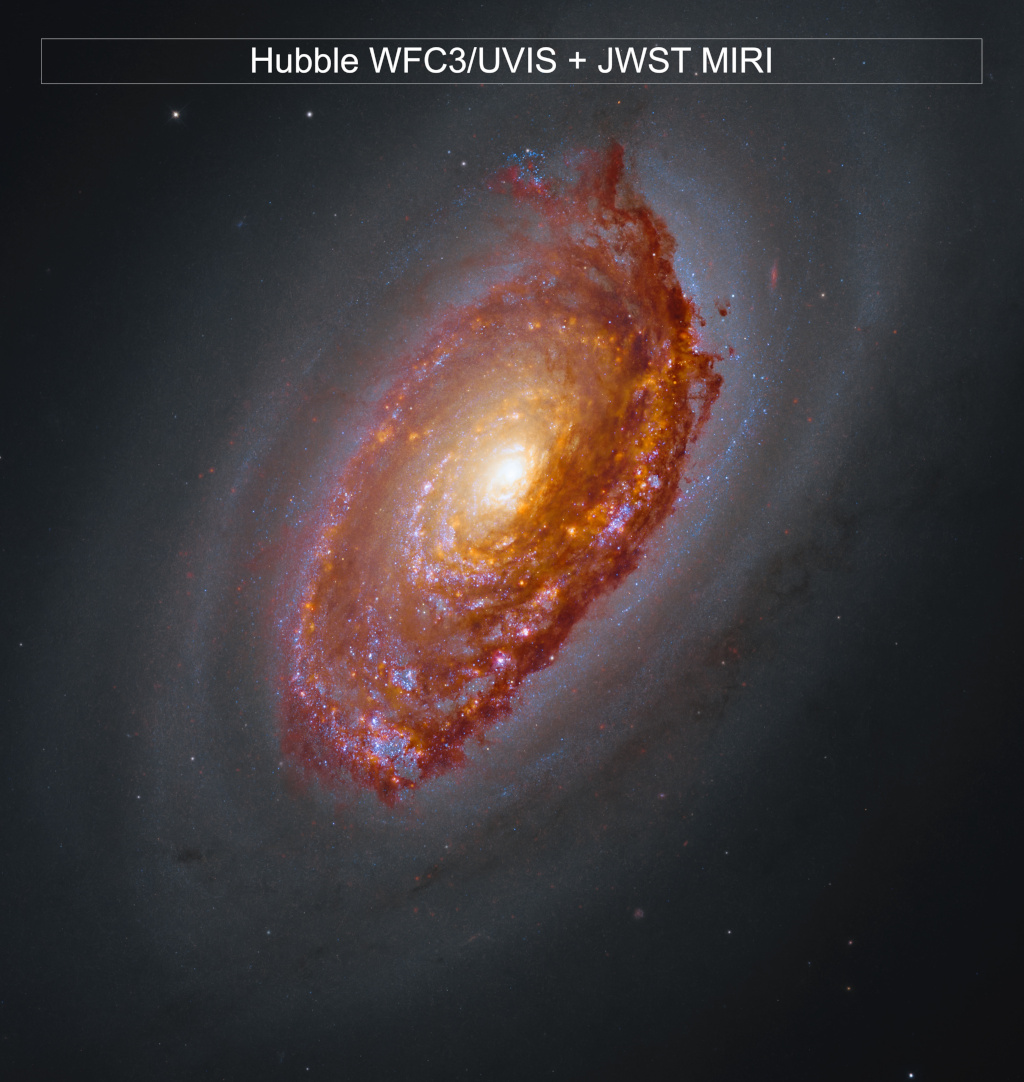
Webb's View of M64
Sometimes where Hubble finds darkness, Webb sees light. An example is today’s composite images of Messier 64 (M64), a nearby spiral galaxy of many names. The dark band of dust partially blocking its bright core earned it the moniker “the Black Eye Galaxy.” Webb’s Mid-InfraRed Instrument (MIRI) sees that dust, shown in red, as it absorbs and re-emits light from surrounding newborn stars. These young stars are embedded in pink star-forming regions in the secondary Hubble-only image. M64’s inner and outer gas regions counter-rotate, creating regions of increased star formation where the two gas “currents” meet and compress. A merger between M64 and a smaller galaxy was likely the cause of the opposing motion of the outer gas. Spiral galaxies were once thought to have peaceful histories. M64 was key evidence that spiral galaxies, including the Milky Way, can and do experience mergers. Webb’s view of M64 will tell astronomers about the structure, motion, and composition of the galaxy’s dust and add context to the galaxy’s merger history and evolution. APOD's main NASA site is moving: From apod.nasa.gov to science.nasa.gov/apod
A 0–9 score for how stirred up Earth’s magnetic field is, measured every 3 hours by magnetometers around the world. 0–2 is quiet, 3–4 is unsettled, and 5 or more is a geomagnetic storm. The higher it goes, the farther from the poles the northern lights reach. Around Kp 5, people in Washington State can sometimes see them low in the north.
- Kp 5 G1 minor
- Kp 6 G2 moderate
- Kp 7 G3 strong
- Kp 8 G4 severe
- Kp 9 G5 extreme
A rough guide based only on the current Kp: Unlikely below 4, Possible at 4–5, Likely at 6–7, Strong at 8+. It isn’t for your exact location, so use “Your sky this week” for odds where you are. Clouds and city lights matter too.
Learn more at NOAA SWPCA stream of charged particles flowing from the Sun, measured by spacecraft about 1.5 million km (1 million miles) toward the Sun from Earth. It usually blows at 300–500 km/s. Faster than about 600 km/s often means stormier space weather, and whatever is measured now reaches Earth roughly 30–60 minutes later.
Learn more at NOAA SWPC