Past Forecasts
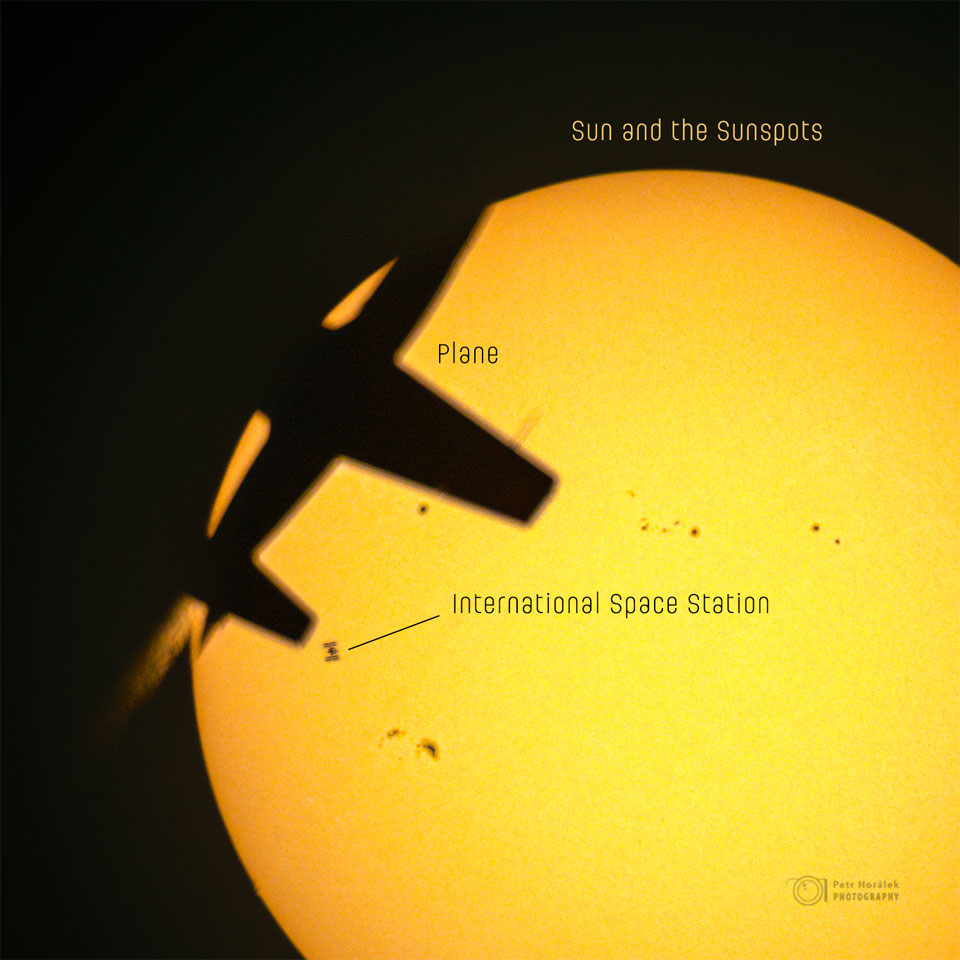
Chance Triple Alignment: Plane, Space Station, Sun
This shot captured an unexpected silhouette. Which is it? It isn't the sunspots, the small dark regions caused by concentrated magnetic fields visible around the Sun's bright disk. Sunspots typically last for weeks and were expected, since these spots were seen previously. It isn’t the International Space Station (ISS), the small dark structure on the middle left. This is because the featured picture was planned with sub-second timing to record the iconic structure passing before the Sun. It is the airplane. Just as this exposure was taking place in June, from Prasek in the Czech Republic, an airplane began its own miniature partial eclipse. The result is this triply aligned image of our Sun. The photographer estimates that the chance of any random Sun image containing silhouettes of both a space station and an airplane, from that location, is about 30 million to one. APOD's main NASA site is moving: From apod.nasa.gov to science.nasa.gov/apod
Credit & Copyright: Petr Horalek / Inst. Physics Opava
A 0–9 score for how stirred up Earth’s magnetic field is, measured every 3 hours by magnetometers around the world. 0–2 is quiet, 3–4 is unsettled, and 5 or more is a geomagnetic storm. The higher it goes, the farther from the poles the northern lights reach. Around Kp 5, people in Washington State can sometimes see them low in the north.
- Kp 5 G1 minor
- Kp 6 G2 moderate
- Kp 7 G3 strong
- Kp 8 G4 severe
- Kp 9 G5 extreme
A rough guide based only on the current Kp: Unlikely below 4, Possible at 4–5, Likely at 6–7, Strong at 8+. It isn’t for your exact location, so use “Your sky this week” for odds where you are. Clouds and city lights matter too.
Learn more at NOAA SWPCA stream of charged particles flowing from the Sun, measured by spacecraft about 1.5 million km (1 million miles) toward the Sun from Earth. It usually blows at 300–500 km/s. Faster than about 600 km/s often means stormier space weather, and whatever is measured now reaches Earth roughly 30–60 minutes later.
Learn more at NOAA SWPC