Past Forecasts
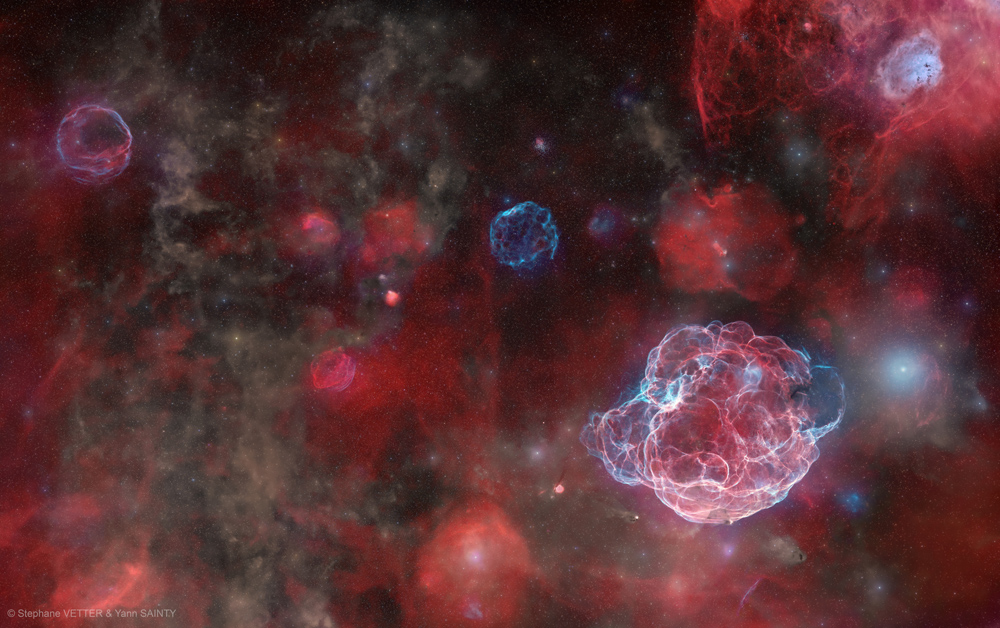
The Ghosts of Five Supernovas
The ghosts of five supernovas haunt this extraordinary image. It was acquired at Oukaïmeden Observatory in Morocco with approximately 200 hours of observations and shows a large patch of the sky, equivalent to the area of one thousand full moons tiled together, in the constellation of Auriga (the charioteer). From left to right, the five supernova remnants visible across the field are G181.1+9.5, G182.4+4.3, G179.0+2.6, G180.0−1.7 (Sh2-240, the Spaghetti Nebula), and G178.2−4.2. They are highlighted in the annotated image, together with open cluster M37 and the Tadpole Nebula. As each explosion expanded into space, it created a growing shell of shocked gas and delicate filamentary structures shown in red (hydrogen) and blue (oxygen), respectively. These ancient stellar explosions happened independently; they are at various distances up to about several thousands of light-years away from Earth and have estimated ages up to tens of thousands of years old. Early humans may have witnessed them as bright new stars, fading over weeks or months. APOD's email for image submissions has changed. Please see: APOD Submissions. APOD's main NASA site is moving : From apod.nasa.gov to science.nasa.gov/apod
Credit & Copyright: Stephane Vetter, Yann Sainty Text: Cecilia Chirenti (NASA GSFC, UMCP, CRESST II)
A 0–9 score for how stirred up Earth’s magnetic field is, measured every 3 hours by magnetometers around the world. 0–2 is quiet, 3–4 is unsettled, and 5 or more is a geomagnetic storm. The higher it goes, the farther from the poles the northern lights reach. Around Kp 5, people in Washington State can sometimes see them low in the north.
- Kp 5 G1 minor
- Kp 6 G2 moderate
- Kp 7 G3 strong
- Kp 8 G4 severe
- Kp 9 G5 extreme
A rough guide based only on the current Kp: Unlikely below 4, Possible at 4–5, Likely at 6–7, Strong at 8+. It isn’t for your exact location, so use “Your sky this week” for odds where you are. Clouds and city lights matter too.
Learn more at NOAA SWPCA stream of charged particles flowing from the Sun, measured by spacecraft about 1.5 million km (1 million miles) toward the Sun from Earth. It usually blows at 300–500 km/s. Faster than about 600 km/s often means stormier space weather, and whatever is measured now reaches Earth roughly 30–60 minutes later.
Learn more at NOAA SWPC