Past Forecasts
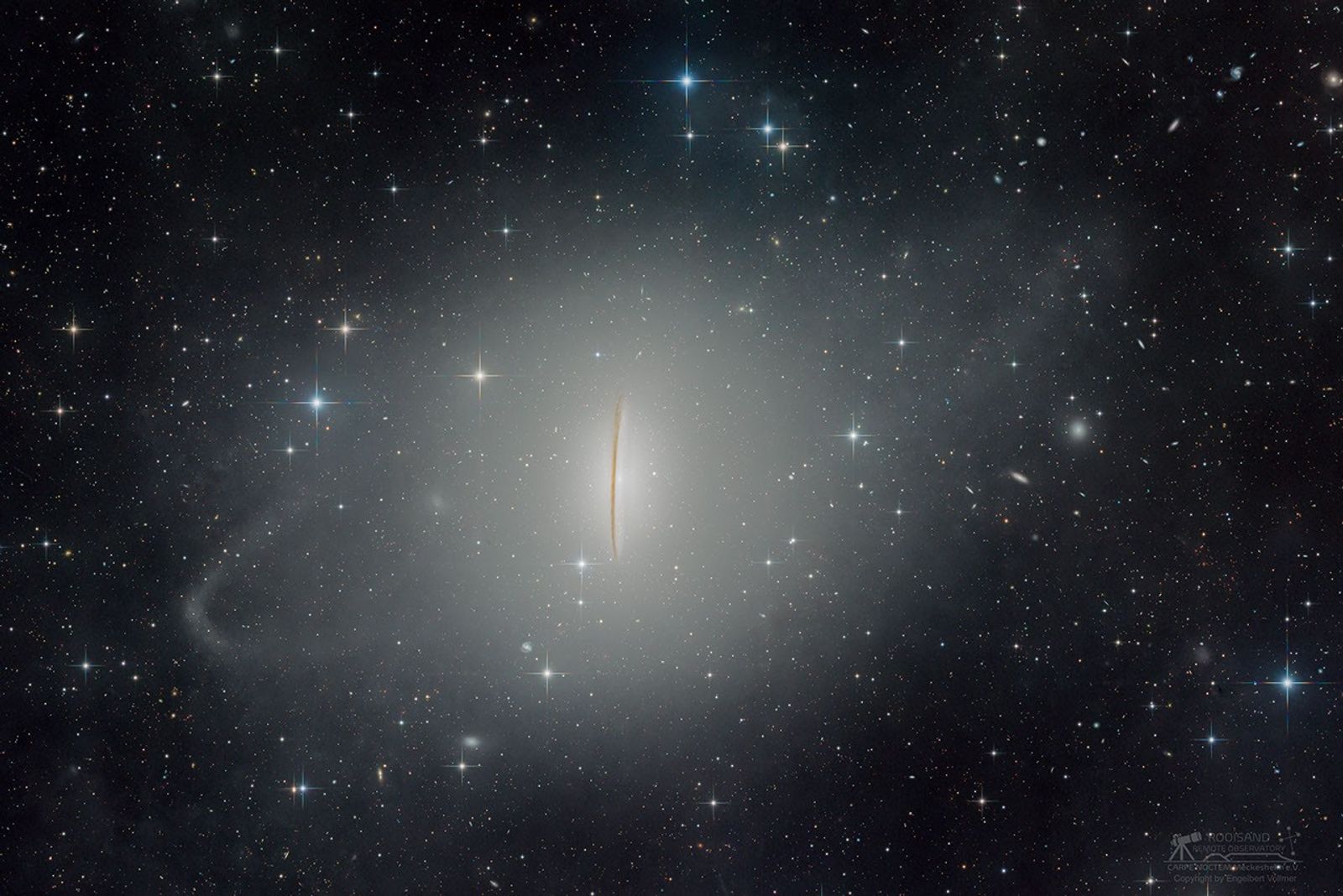
M104: The Sombrero Galaxy's Tidal Streams
Explanation: A deep image of the Sombrero galaxy reveals surprises. M104 is named the Sombrero galaxy because, on shorter exposures, it looks like a hat. A key defining feature of this huge galaxy is a dark brim of dust that circles the disk galaxy's center. A much longer exposure, however, brings up a hairy past where a bright, hazy halo is revealed that extends well past the central disk and contains many unresolved stars. Surprisingly, in this stellar haze, structures can be seen that include a diagonal ring. These structures and tidal streams provide fresh evidence that M104 had a violent past and is surely the result of collisions and mergers of smaller galaxies. Light takes about 30 million years to reach us from the Sombrero galaxy, which fully spans about 150 thousand light years across. The featured image was taken over seven days in mid-2026 from Namibia. Your Sky Surprise: What picture did APOD feature on your birthday? (post 1995) Tomorrow's picture: a smile
Credit & Copyright: Engelbert Vollmer
A 0–9 score for how stirred up Earth’s magnetic field is, measured every 3 hours by magnetometers around the world. 0–2 is quiet, 3–4 is unsettled, and 5 or more is a geomagnetic storm. The higher it goes, the farther from the poles the northern lights reach. Around Kp 5, people in Washington State can sometimes see them low in the north.
- Kp 5 G1 minor
- Kp 6 G2 moderate
- Kp 7 G3 strong
- Kp 8 G4 severe
- Kp 9 G5 extreme
A rough guide based only on the current Kp: Unlikely below 4, Possible at 4–5, Likely at 6–7, Strong at 8+. It isn’t for your exact location, so use “Your sky this week” for odds where you are. Clouds and city lights matter too.
Learn more at NOAA SWPCA stream of charged particles flowing from the Sun, measured by spacecraft about 1.5 million km (1 million miles) toward the Sun from Earth. It usually blows at 300–500 km/s. Faster than about 600 km/s often means stormier space weather, and whatever is measured now reaches Earth roughly 30–60 minutes later.
Learn more at NOAA SWPC