Past Forecasts
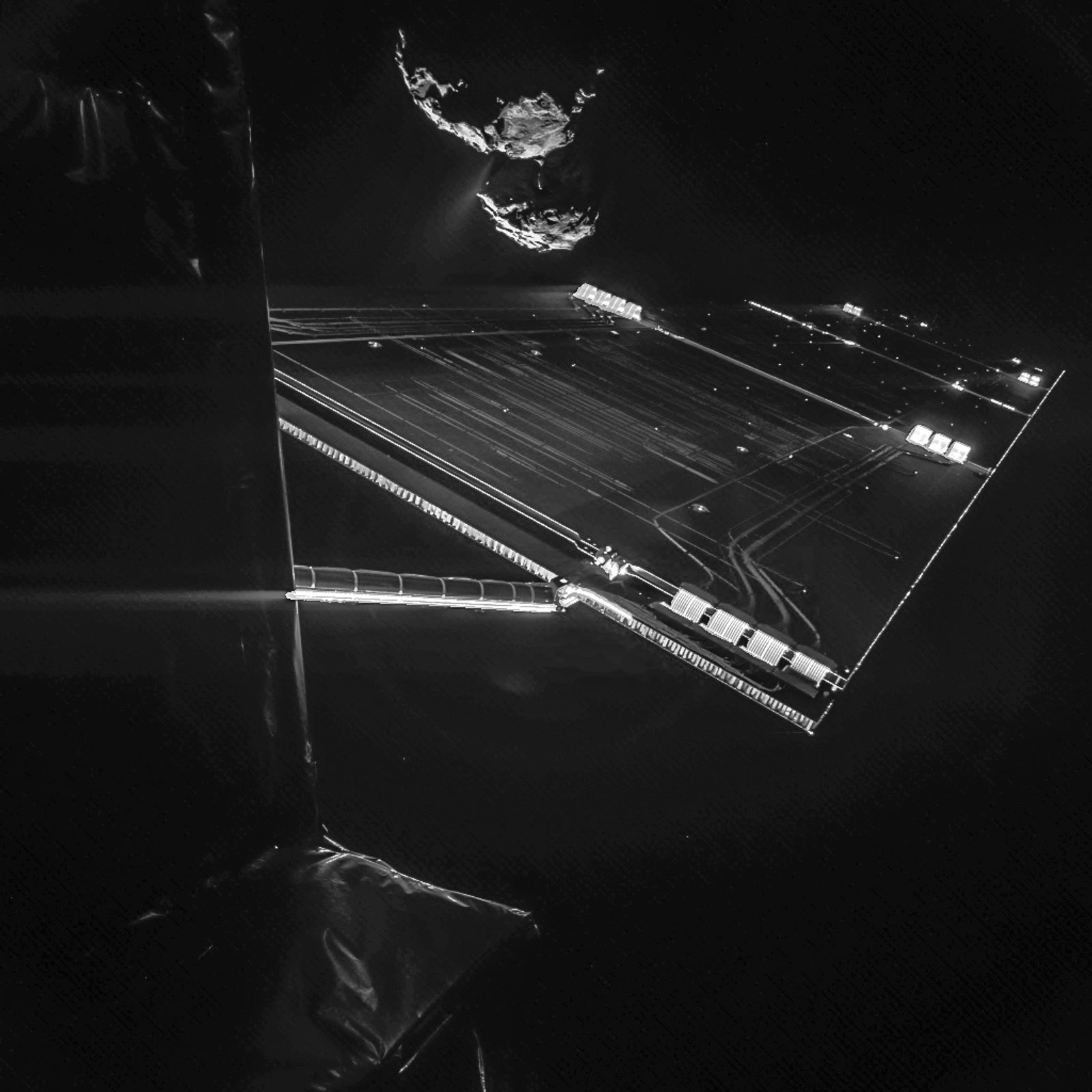
Rosetta's Selfie
Explanation: This Rosetta spacecraft selfie was snapped on October 7th, 2014. At the time the comet-chasing spacecraft was about 472 million kilometers from planet Earth, but only 16 kilometers from the surface of comet 67P/Churyumov-Gerasimenko. Looming beyond the spacecraft near the top of the frame, dust and gas stream away from the comet's curious double-lobed nucleus. Bright sunlight glints off one of Rosetta's 14 meter long solar arrays. In fact, two exposures, one short and one long, were combined to record the dramatic high contrast scene using the CIVA camera system on Rosetta's still-attached Philae lander. Its chosen primary landing site was on the visible hemisphere of the smaller lobe of the nucleus. This was the last image from Philae's camera before the lander separated from Rosetta on November 12. Shortly after separation Philae took another image looking back toward the orbiter and began its descent to the nucleus of the comet. Tomorrow's picture: dark matters
Credit & Copyright: ESA/Rosetta/Philae/CIVA
A 0–9 score for how stirred up Earth’s magnetic field is, measured every 3 hours by magnetometers around the world. 0–2 is quiet, 3–4 is unsettled, and 5 or more is a geomagnetic storm. The higher it goes, the farther from the poles the northern lights reach. Around Kp 5, people in Washington State can sometimes see them low in the north.
- Kp 5 G1 minor
- Kp 6 G2 moderate
- Kp 7 G3 strong
- Kp 8 G4 severe
- Kp 9 G5 extreme
A rough guide based only on the current Kp: Unlikely below 4, Possible at 4–5, Likely at 6–7, Strong at 8+. It isn’t for your exact location, so use “Your sky this week” for odds where you are. Clouds and city lights matter too.
Learn more at NOAA SWPCA stream of charged particles flowing from the Sun, measured by spacecraft about 1.5 million km (1 million miles) toward the Sun from Earth. It usually blows at 300–500 km/s. Faster than about 600 km/s often means stormier space weather, and whatever is measured now reaches Earth roughly 30–60 minutes later.
Learn more at NOAA SWPCISS · 7
-
 Anil Menon
NASA
-
 Anna Kikina
Roscosmos
-
Jessica Watkins
NASA
-
 Joshua Kutryk
CSA
-
Luke Delaney
NASA
-
Pyotr Dubrov
Roscosmos
-
Sergey Teteryatnikov
Roscosmos
Tiangong · 3
-
 Lai Ka-ying
CNSA
-
Zhang Zhiyuan
CNSA
-
Zhu Yangzhu
CNSA