Past Forecasts
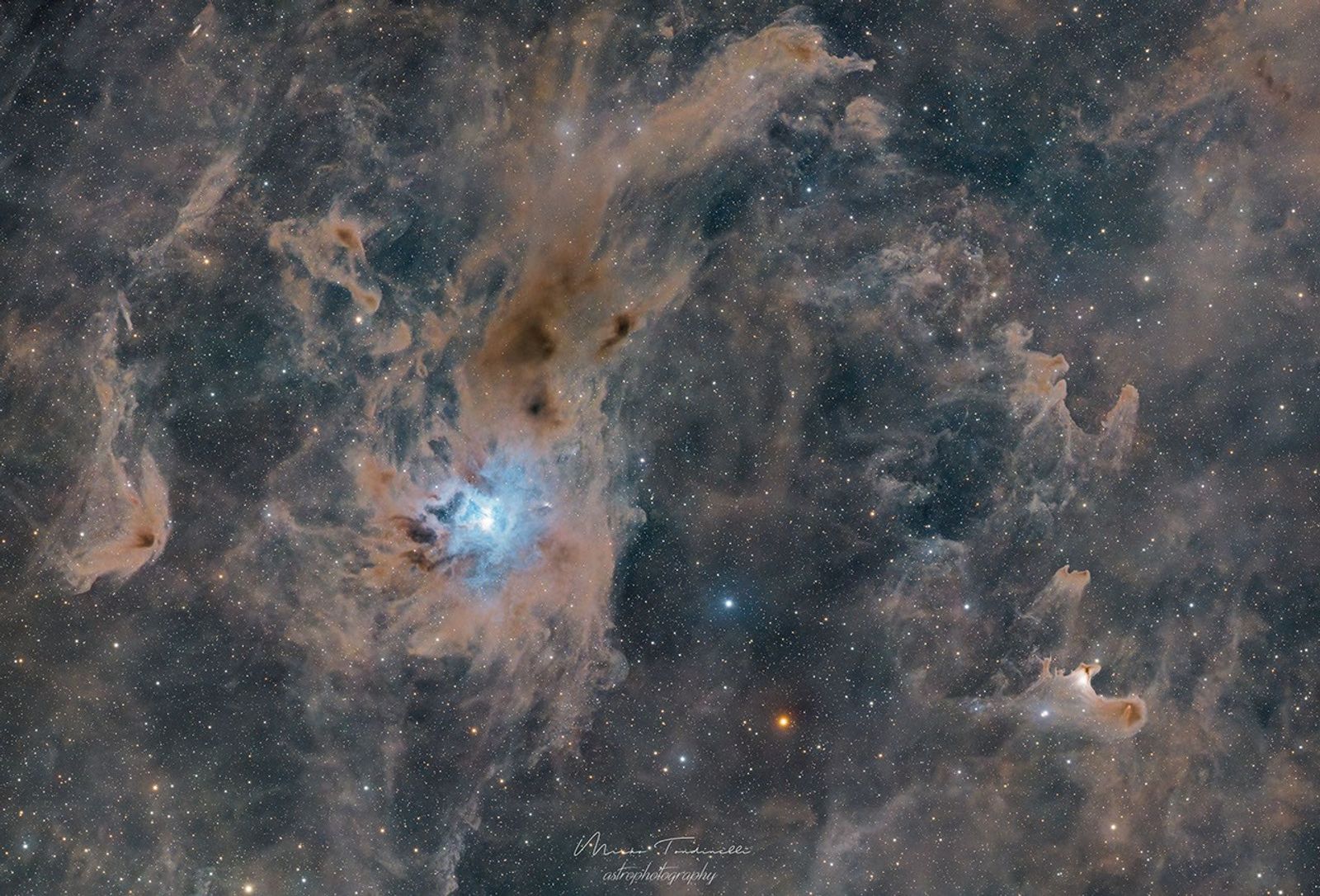
Haunting the Cepheus Flare
Explanation: Spooky shapes seem to haunt this dusty expanse, drifting through the night in the royal constellation Cepheus. Of course, the shapes are cosmic dust clouds visible in dimly reflected starlight. Far from your own neighborhood, they lurk above the plane of the Milky Way at the edge of the Cepheus Flare molecular cloud complex some 1,200 light-years away. Over 2 light-years across and brighter than most of the other ghostly apparitions, vdB 141 or Sh2-136 is also known as the Ghost Nebula. It lies at lower right in the starry field of view. Inside the Ghost Nebula are reddish telltale signs of dense cores collapsing in the early stages of star formation. With the eerie hue of interstellar dust reflecting bluish light from hot young stars of NGC 7023, the Iris Nebula stands out against the dark just left of center. In the broad telescopic frame, these fertile interstellar dust fields stretch almost six full moons across the sky. Tomorrow's picture: night on a spooky planet
Credit & Copyright: Mirko Tondinelli
A 0–9 score for how stirred up Earth’s magnetic field is, measured every 3 hours by magnetometers around the world. 0–2 is quiet, 3–4 is unsettled, and 5 or more is a geomagnetic storm. The higher it goes, the farther from the poles the northern lights reach. Around Kp 5, people in Washington State can sometimes see them low in the north.
- Kp 5 G1 minor
- Kp 6 G2 moderate
- Kp 7 G3 strong
- Kp 8 G4 severe
- Kp 9 G5 extreme
A rough guide based only on the current Kp: Unlikely below 4, Possible at 4–5, Likely at 6–7, Strong at 8+. It isn’t for your exact location, so use “Your sky this week” for odds where you are. Clouds and city lights matter too.
Learn more at NOAA SWPCA stream of charged particles flowing from the Sun, measured by spacecraft about 1.5 million km (1 million miles) toward the Sun from Earth. It usually blows at 300–500 km/s. Faster than about 600 km/s often means stormier space weather, and whatever is measured now reaches Earth roughly 30–60 minutes later.
Learn more at NOAA SWPCISS · 7
-
 Anil Menon
NASA
-
 Anna Kikina
Roscosmos
-
Jessica Watkins
NASA
-
 Joshua Kutryk
CSA
-
Luke Delaney
NASA
-
Pyotr Dubrov
Roscosmos
-
Sergey Teteryatnikov
Roscosmos
Tiangong · 3
-
 Lai Ka-ying
CNSA
-
Zhang Zhiyuan
CNSA
-
Zhu Yangzhu
CNSA