Past Forecasts
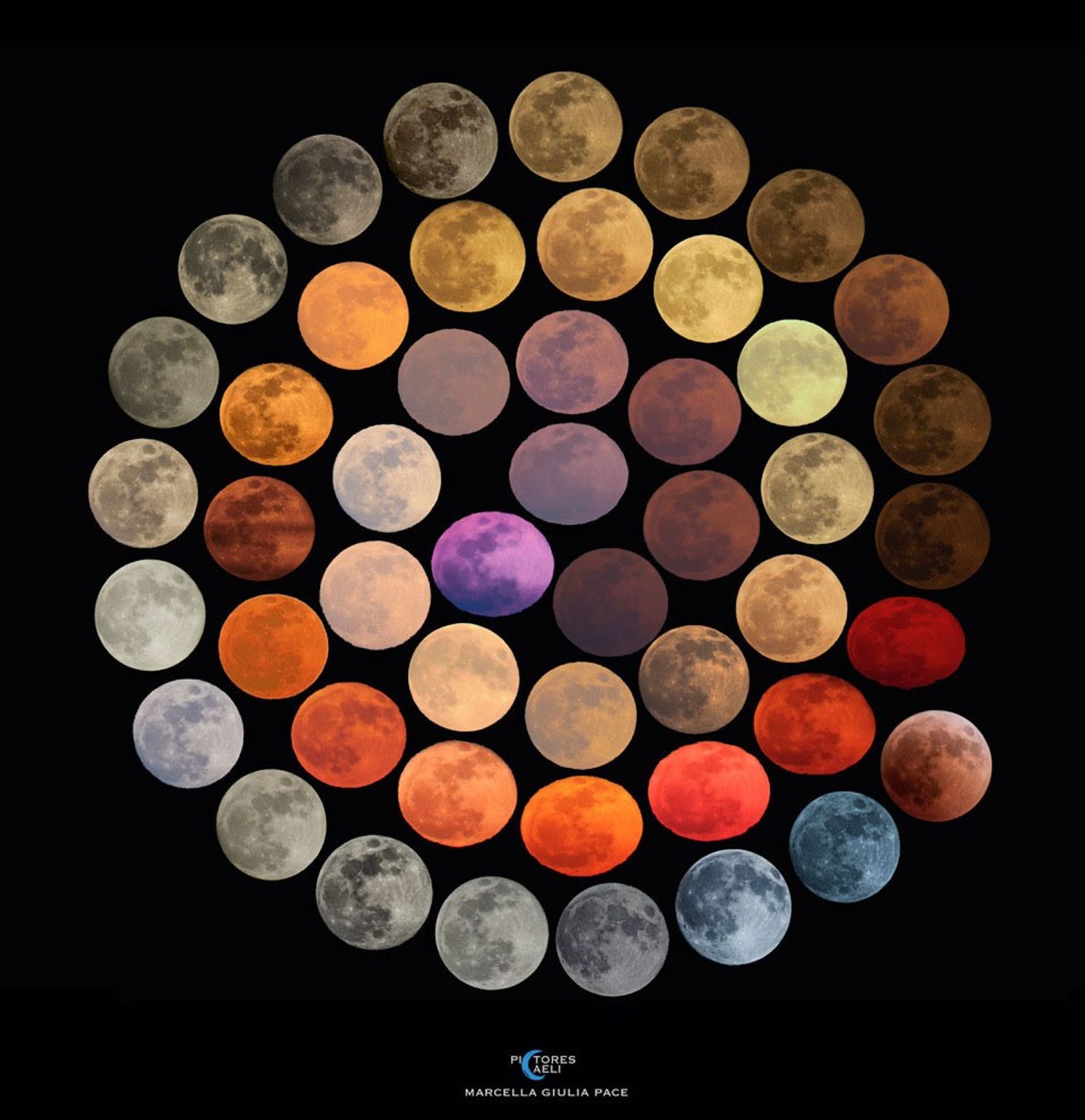
Colors of the Moon
Explanation: What color is the Moon? It depends on the night -- and the time. Outside of the Earth's atmosphere, the dark Moon, which shines by reflected sunlight, appears a magnificently brown-tinged gray. The featured image highlights a collection of apparent colors of the full moon on Earth, documented by one astrophotographer over 10 years from different locations across Italy. A red- or yellow-colored moon usually indicates a moon seen near the horizon. There, some of the blue light has been scattered away by a long path through the Earth's atmosphere, sometimes laden with fine dust. A blue-colored moon is more rare and can indicate an atmosphere carrying larger dust particles. What created the purple moon is unclear -- it may be a combination of several effects. The last image captures the total lunar eclipse of 2018 July -- where the moon, in Earth's shadow, appeared a faint red -- due to light refracted through air around the Earth. Have you ever seen an unusually colorful Moon? Tomorrow's picture: open space
Credit & Copyright: Marcella Giulia Pace
A 0–9 score for how stirred up Earth’s magnetic field is, measured every 3 hours by magnetometers around the world. 0–2 is quiet, 3–4 is unsettled, and 5 or more is a geomagnetic storm. The higher it goes, the farther from the poles the northern lights reach. Around Kp 5, people in Washington State can sometimes see them low in the north.
- Kp 5 G1 minor
- Kp 6 G2 moderate
- Kp 7 G3 strong
- Kp 8 G4 severe
- Kp 9 G5 extreme
A rough guide based only on the current Kp: Unlikely below 4, Possible at 4–5, Likely at 6–7, Strong at 8+. It isn’t for your exact location, so use “Your sky this week” for odds where you are. Clouds and city lights matter too.
Learn more at NOAA SWPCA stream of charged particles flowing from the Sun, measured by spacecraft about 1.5 million km (1 million miles) toward the Sun from Earth. It usually blows at 300–500 km/s. Faster than about 600 km/s often means stormier space weather, and whatever is measured now reaches Earth roughly 30–60 minutes later.
Learn more at NOAA SWPCISS · 7
-
 Anil Menon
NASA
-
 Anna Kikina
Roscosmos
-
Jessica Watkins
NASA
-
 Joshua Kutryk
CSA
-
Luke Delaney
NASA
-
Pyotr Dubrov
Roscosmos
-
Sergey Teteryatnikov
Roscosmos
Tiangong · 3
-
 Lai Ka-ying
CNSA
-
Zhang Zhiyuan
CNSA
-
Zhu Yangzhu
CNSA