Past Forecasts
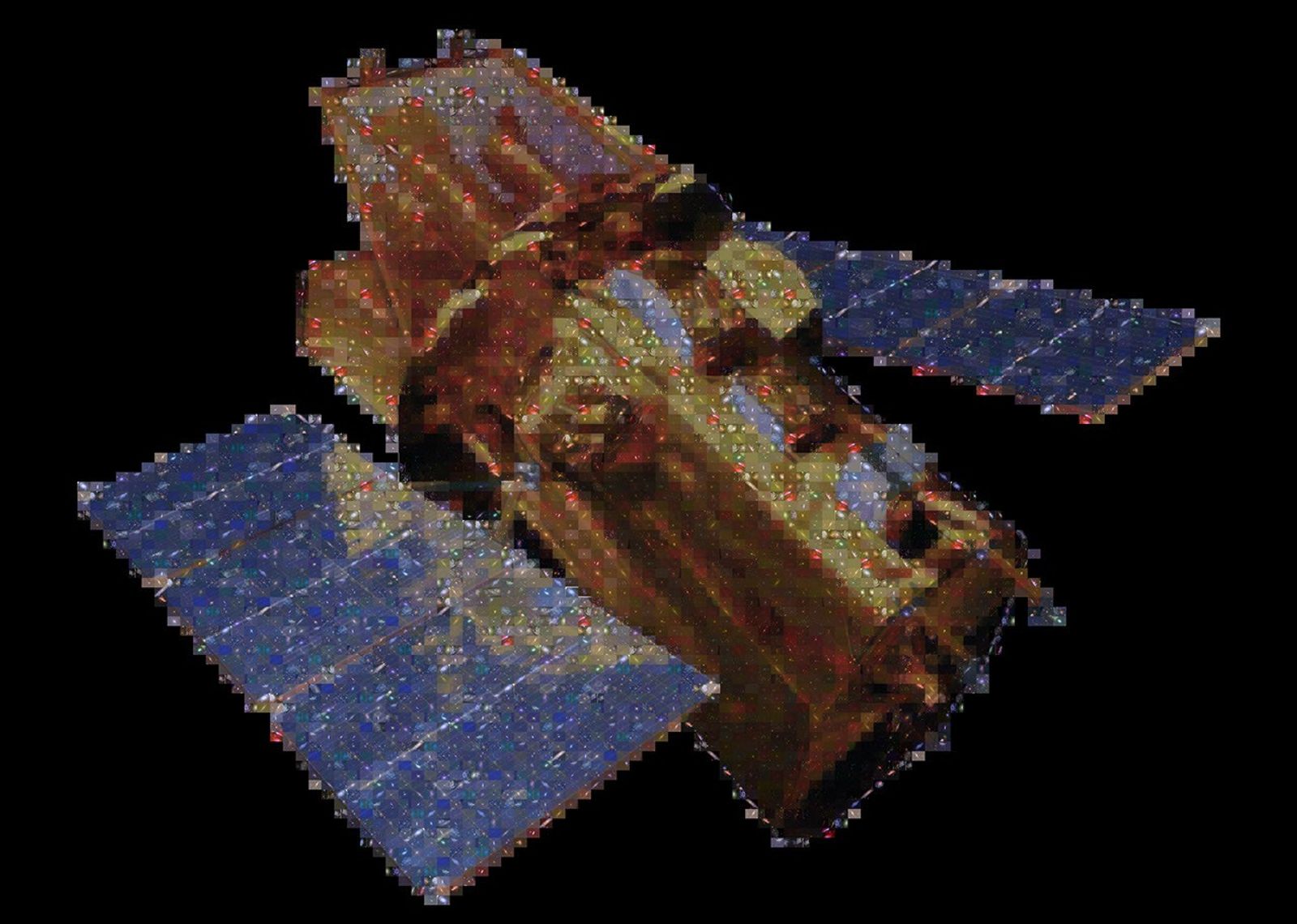
A Farewell to Swift
Explanation: It is time to say goodbye to NASA's Neil Gehrels Swift Observatory. After nearly 22 years of service, the satellite re-entered Earth's atmosphere on November 4 at 7:39 EST over the North Sumatra region of Indonesia. The featured image is a mosaic created in 2018 using the first one million images captured by the satellite's Ultraviolet/Optical Telescope. Swift had a combination of instruments, including an X-ray telescope and a gamma-ray telescope, that worked together to enable humanity to study, in unprecedented detail, the fastest and most energetic explosions in the universe. The most recent solar maximum accelerated the decay of the satellite's orbit. An innovative mission to rescue Swift by boosting its orbit was not successful. Swift burned on reentry like a shooting star, but the impressive data acquired by the telescope over its mission will continue to bring light to the mysteries of the cosmos for years to come. May it keep inspiring new missions to boldly go into space, explore new data and seek out new science. Tomorrow's picture: what's next?
Credit & Copyright: NASA/Swift and AndreaMosaic
A 0–9 score for how stirred up Earth’s magnetic field is, measured every 3 hours by magnetometers around the world. 0–2 is quiet, 3–4 is unsettled, and 5 or more is a geomagnetic storm. The higher it goes, the farther from the poles the northern lights reach. Around Kp 5, people in Washington State can sometimes see them low in the north.
- Kp 5 G1 minor
- Kp 6 G2 moderate
- Kp 7 G3 strong
- Kp 8 G4 severe
- Kp 9 G5 extreme
A rough guide based only on the current Kp: Unlikely below 4, Possible at 4–5, Likely at 6–7, Strong at 8+. It isn’t for your exact location, so use “Your sky this week” for odds where you are. Clouds and city lights matter too.
Learn more at NOAA SWPCA stream of charged particles flowing from the Sun, measured by spacecraft about 1.5 million km (1 million miles) toward the Sun from Earth. It usually blows at 300–500 km/s. Faster than about 600 km/s often means stormier space weather, and whatever is measured now reaches Earth roughly 30–60 minutes later.
Learn more at NOAA SWPCISS · 7
-
 Anil Menon
NASA
-
 Anna Kikina
Roscosmos
-
Jessica Watkins
NASA
-
 Joshua Kutryk
CSA
-
Luke Delaney
NASA
-
Pyotr Dubrov
Roscosmos
-
Sergey Teteryatnikov
Roscosmos
Tiangong · 3
-
 Lai Ka-ying
CNSA
-
Zhang Zhiyuan
CNSA
-
Zhu Yangzhu
CNSA