Past Forecasts
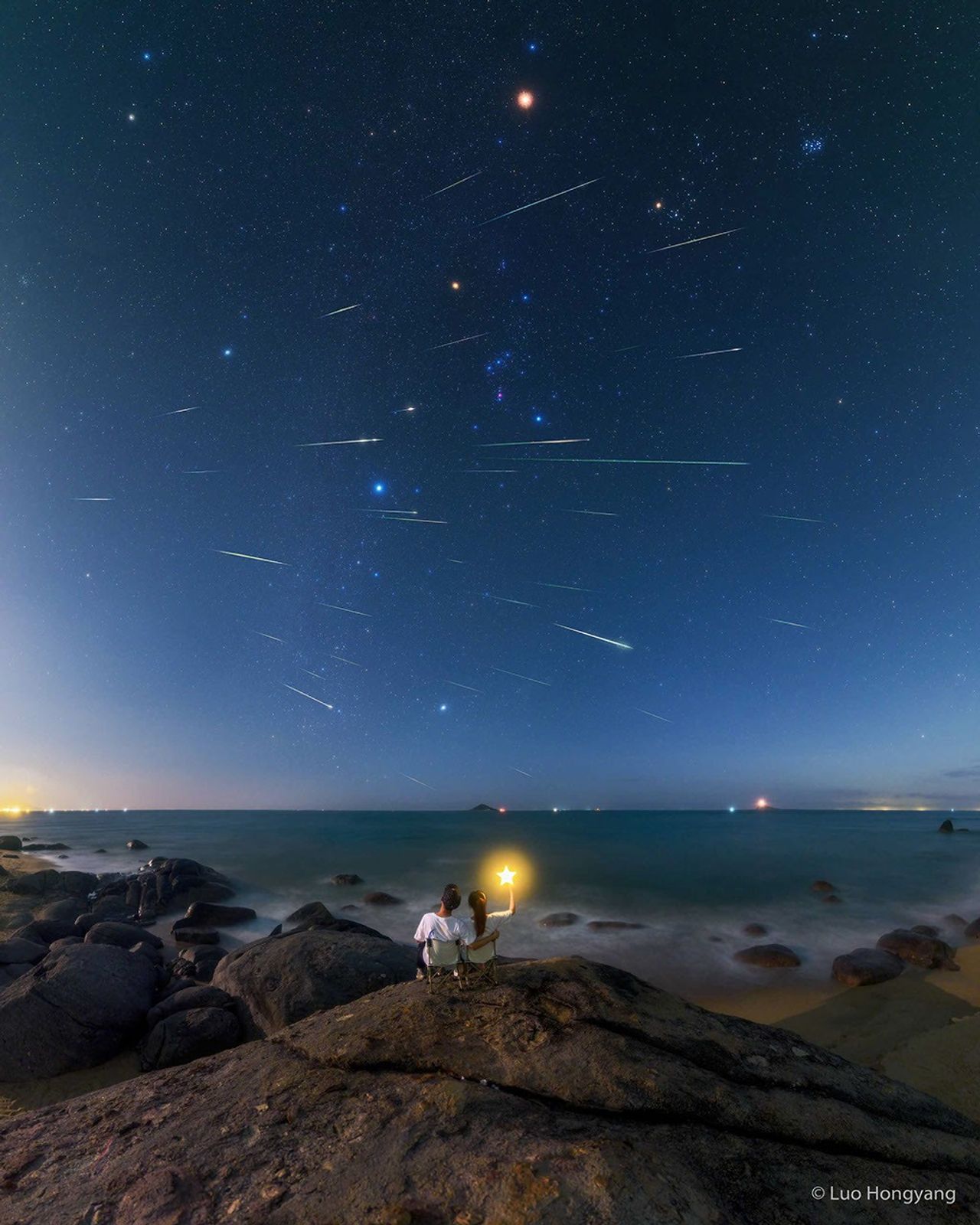
Leonid Meteors Through Orion
Explanation: Where will the next meteor appear? Even during a meteor shower, it is practically impossible to know. Therefore, a good way to enjoy a meteor shower is to find a place where you can sit comfortably and monitor a great expanse of dark sky. And it may be satisfying to share this experience with a friend. The meteor shower depicted was the 2022 Leonids and the view is from Hainan, China looking out over the South China Sea. Meteor streaks captured over a few hours were isolated and added to a foreground image recorded earlier. Leonid meteor streaks trace back to the constellation of Leo and were here seen streaking across the constellation of Orion. The bright red planet Mars appears near the top of the image. The Leonids peak in mid-November every year and so will peak again this week. Bonding over their love of astronomy, the two pictured meteor enthusiasts, shown celebrating their common birthday this month, were later married. Tomorrow's picture: open space
Credit & Copyright: Luo Hongyang
A 0–9 score for how stirred up Earth’s magnetic field is, measured every 3 hours by magnetometers around the world. 0–2 is quiet, 3–4 is unsettled, and 5 or more is a geomagnetic storm. The higher it goes, the farther from the poles the northern lights reach. Around Kp 5, people in Washington State can sometimes see them low in the north.
- Kp 5 G1 minor
- Kp 6 G2 moderate
- Kp 7 G3 strong
- Kp 8 G4 severe
- Kp 9 G5 extreme
A rough guide based only on the current Kp: Unlikely below 4, Possible at 4–5, Likely at 6–7, Strong at 8+. It isn’t for your exact location, so use “Your sky this week” for odds where you are. Clouds and city lights matter too.
Learn more at NOAA SWPCA stream of charged particles flowing from the Sun, measured by spacecraft about 1.5 million km (1 million miles) toward the Sun from Earth. It usually blows at 300–500 km/s. Faster than about 600 km/s often means stormier space weather, and whatever is measured now reaches Earth roughly 30–60 minutes later.
Learn more at NOAA SWPCISS · 7
-
 Anil Menon
NASA
-
 Anna Kikina
Roscosmos
-
Jessica Watkins
NASA
-
 Joshua Kutryk
CSA
-
Luke Delaney
NASA
-
Pyotr Dubrov
Roscosmos
-
Sergey Teteryatnikov
Roscosmos
Tiangong · 3
-
 Lai Ka-ying
CNSA
-
Zhang Zhiyuan
CNSA
-
Zhu Yangzhu
CNSA