Past Forecasts
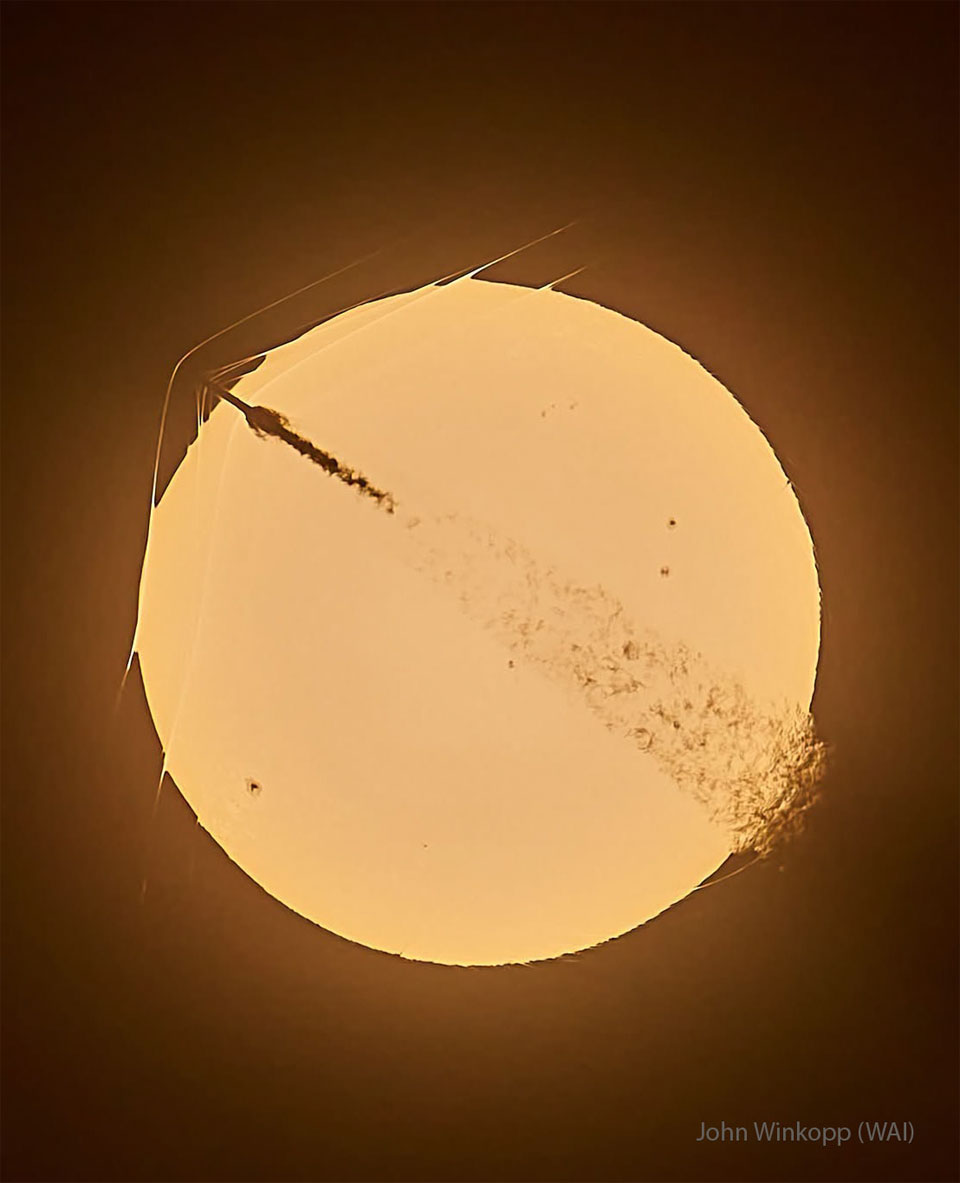
Triple Shockwave from Sun Crossing Rocket
What's happening to this Sun-crossing rocket? The SpaceX Falcon 9 rocket, visible on the upper left, launched only about one minute before this amazing image was captured. As it rose to low Earth orbit from Cape Canaveral, Florida, USA, in late May, the rocket became supersonic before it crossed the disk of the distant Sun -- from the perspective of the well-placed photographer. The spacecraft's high speed caused bow-shaped compressed-air shockwaves to form across leading surfaces, with at least three visible even outside the Sun's disk because they refract sunlight. The trailing exhaust caused turbulence visible on the lower right. None of this was damaging to the robotic Starlink 10-53 mission, which delivered 29 communications satellites to low Earth orbit as planned. And if that isn't amazing enough - the Sun had spots! Sky Surprise: What picture did APOD feature on your birthday? (after 1995)
Credit & Copyright: John Winkopp (WAI Media)
A 0–9 score for how stirred up Earth’s magnetic field is, measured every 3 hours by magnetometers around the world. 0–2 is quiet, 3–4 is unsettled, and 5 or more is a geomagnetic storm. The higher it goes, the farther from the poles the northern lights reach. Around Kp 5, people in Washington State can sometimes see them low in the north.
- Kp 5 G1 minor
- Kp 6 G2 moderate
- Kp 7 G3 strong
- Kp 8 G4 severe
- Kp 9 G5 extreme
A rough guide based only on the current Kp: Unlikely below 4, Possible at 4–5, Likely at 6–7, Strong at 8+. It isn’t for your exact location, so use “Your sky this week” for odds where you are. Clouds and city lights matter too.
Learn more at NOAA SWPCA stream of charged particles flowing from the Sun, measured by spacecraft about 1.5 million km (1 million miles) toward the Sun from Earth. It usually blows at 300–500 km/s. Faster than about 600 km/s often means stormier space weather, and whatever is measured now reaches Earth roughly 30–60 minutes later.
Learn more at NOAA SWPC