Past Forecasts
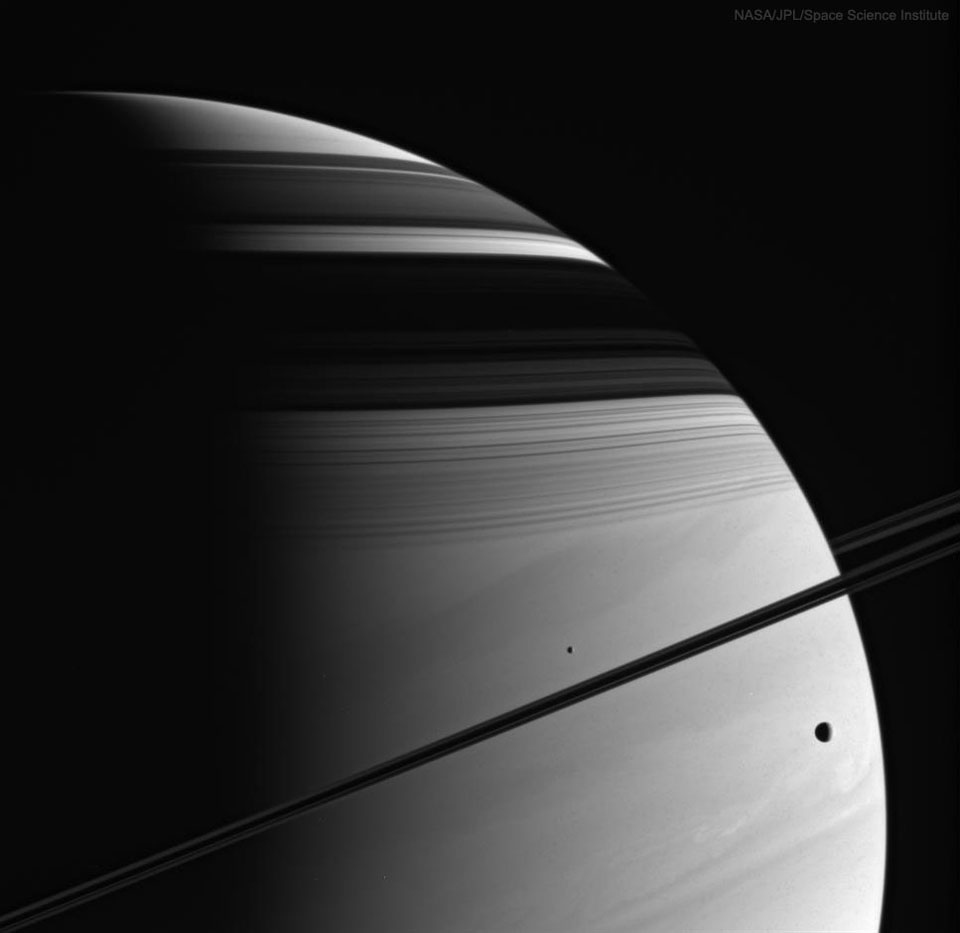
Moons, Rings, Shadows, Clouds: Saturn (Cassini)
While cruising around Saturn, be on the lookout for picturesque arrangements of moons, rings, and shadows. One such striking sight occurred in 2005 and was captured by the then Saturn-orbiting Cassini spacecraft. In the featured image, moons Mimas (left) and Tethys (right) are visible on either side of Saturn's thin rings, which are seen nearly edge-on. Across the top of Saturn are dark shadows of the wide rings, exhibiting their impressive complexity. The violet-light image brings up the texture of the backdrop: Saturn's clouds. Cassini orbited Saturn from 2004 until mid-2017, when the robotic spacecraft was directed to dive into Saturn to keep it from contaminating any moons. Explore the Universe: Random APOD Generator
A 0–9 score for how stirred up Earth’s magnetic field is, measured every 3 hours by magnetometers around the world. 0–2 is quiet, 3–4 is unsettled, and 5 or more is a geomagnetic storm. The higher it goes, the farther from the poles the northern lights reach. Around Kp 5, people in Washington State can sometimes see them low in the north.
- Kp 5 G1 minor
- Kp 6 G2 moderate
- Kp 7 G3 strong
- Kp 8 G4 severe
- Kp 9 G5 extreme
A rough guide based only on the current Kp: Unlikely below 4, Possible at 4–5, Likely at 6–7, Strong at 8+. It isn’t for your exact location, so use “Your sky this week” for odds where you are. Clouds and city lights matter too.
Learn more at NOAA SWPCA stream of charged particles flowing from the Sun, measured by spacecraft about 1.5 million km (1 million miles) toward the Sun from Earth. It usually blows at 300–500 km/s. Faster than about 600 km/s often means stormier space weather, and whatever is measured now reaches Earth roughly 30–60 minutes later.
Learn more at NOAA SWPC