Past Forecasts
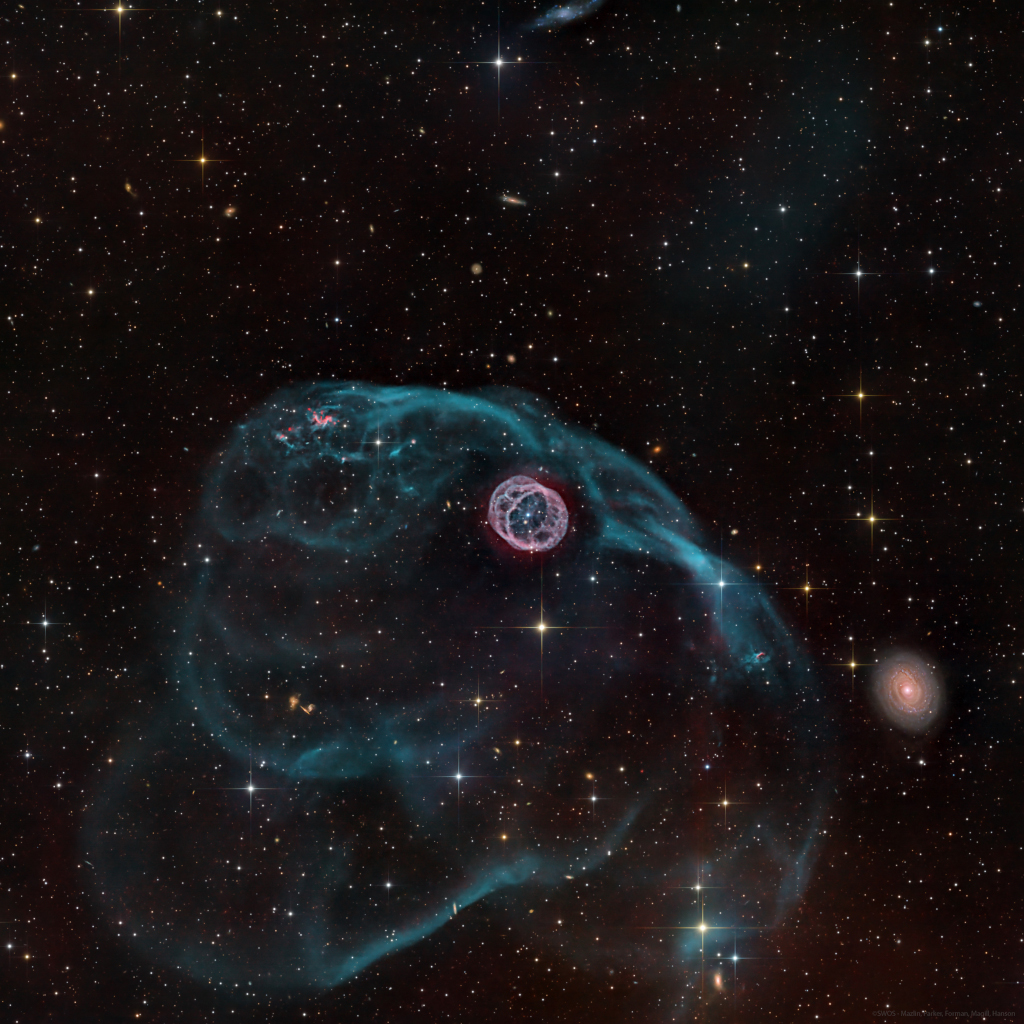
Longmore 8: The Hamster Wheel Nebula
How did a hamster wheel get into space? The Hamster Wheel Nebula (Longmore 8) was discovered by Andrew Longmore in 1976 as a part of a larger survey of the southern sky. This survey employed several improvements in photographic technology, including the use of highly sensitive film, to capture deeper and fainter objects on plates that were examined by eye and catalogued. The featured image, taken at Observatorio El Sauce in Chile, depicts an intricate wheel structure of glowing hydrogen that was thrown out into space by a dying star and ionized by the leftover white dwarf. This structure was barely visible on the original plate, emphasizing the power of modern telescopes and cameras. Two opposing clumps of red hydrogen gas encased in the blue veil of ionized oxygen hint at the presence of a companion to the bright white dwarf at the wheel’s center!
Credit & Copyright: Mazlin, Parker, Forman, Magill, Hanson Text: Keighley Rockcliffe (NASA GSFC, UMBC CSST, CRESST II)
A 0–9 score for how stirred up Earth’s magnetic field is, measured every 3 hours by magnetometers around the world. 0–2 is quiet, 3–4 is unsettled, and 5 or more is a geomagnetic storm. The higher it goes, the farther from the poles the northern lights reach. Around Kp 5, people in Washington State can sometimes see them low in the north.
- Kp 5 G1 minor
- Kp 6 G2 moderate
- Kp 7 G3 strong
- Kp 8 G4 severe
- Kp 9 G5 extreme
A rough guide based only on the current Kp: Unlikely below 4, Possible at 4–5, Likely at 6–7, Strong at 8+. It isn’t for your exact location, so use “Your sky this week” for odds where you are. Clouds and city lights matter too.
Learn more at NOAA SWPCA stream of charged particles flowing from the Sun, measured by spacecraft about 1.5 million km (1 million miles) toward the Sun from Earth. It usually blows at 300–500 km/s. Faster than about 600 km/s often means stormier space weather, and whatever is measured now reaches Earth roughly 30–60 minutes later.
Learn more at NOAA SWPC