Past Forecasts
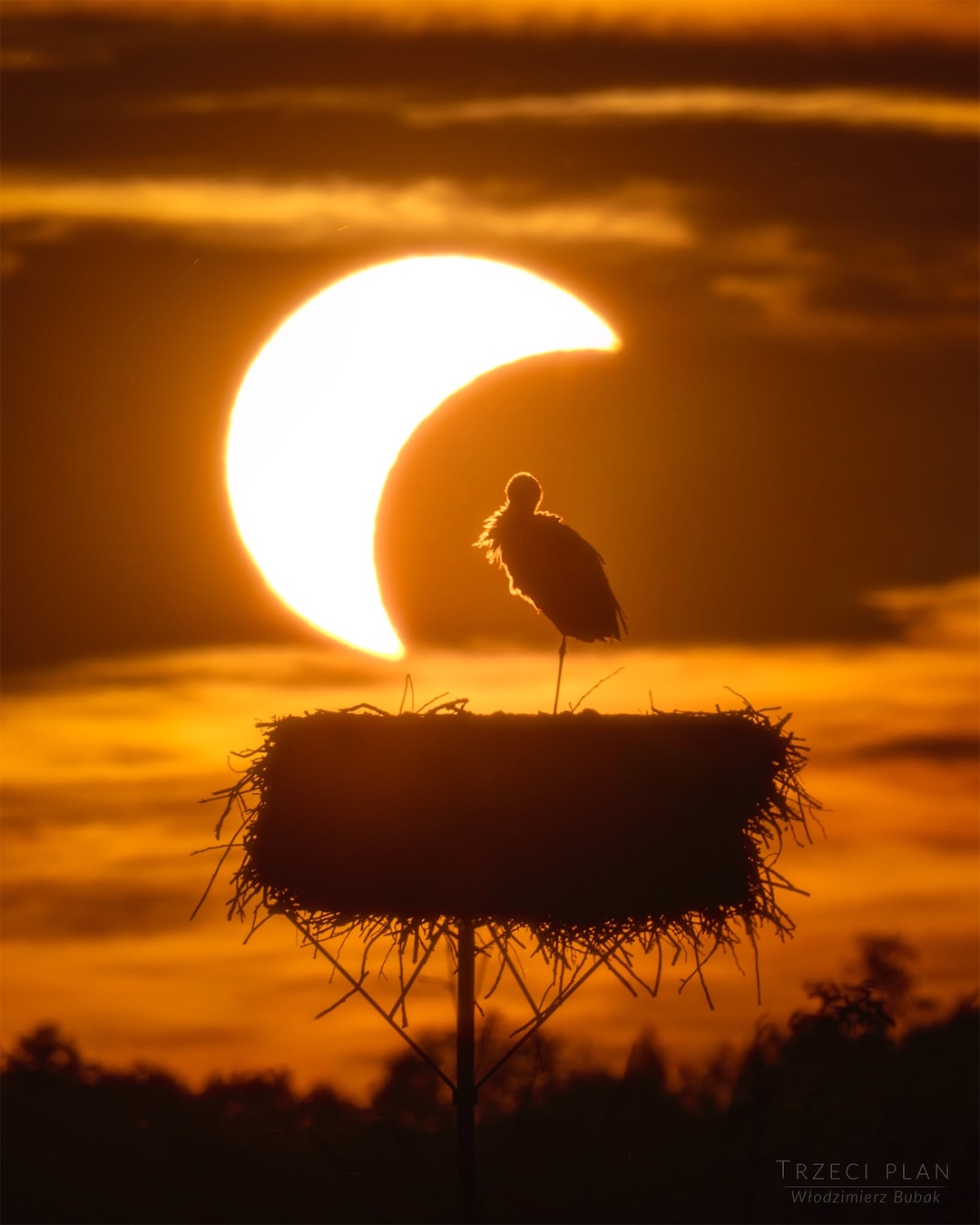
The Eclipse and the Stork
How do animals react to a total solar eclipse? The featured image shows a stork roosting on her nest in Poland at a partial phase of the recent total solar eclipse. If you are lucky enough to experience a total eclipse somewhere quiet and close to nature, you may be able to notice unusual daytime animal behaviors. During totality, you may hear nighttime sounds like crickets and frogs and see fireflies. In the dark, most birds are quiet. Thinking that it is time to go to bed, ducks and other waterfowl prepare to sleep on one leg, with their heads turned around and their beaks tucked into their back feathers (they don't really sleep with their heads tucked under one wing). When sunlight returns at the end of totality, songbirds greet the new "morning" with their dawn songs. The crickets and frogs go quiet again. Animals and people resume their lifes, only briefly disturbed by the chance alignment of our Sun and Moon. APOD's main NASA site is moving : From apod.nasa.gov to science.nasa.gov/apod
Credit & Copyright: Włodzimierz Bubak Text: Cecilia Chirenti (NASA GSFC, UMCP, CRESST II)
A 0–9 score for how stirred up Earth’s magnetic field is, measured every 3 hours by magnetometers around the world. 0–2 is quiet, 3–4 is unsettled, and 5 or more is a geomagnetic storm. The higher it goes, the farther from the poles the northern lights reach. Around Kp 5, people in Washington State can sometimes see them low in the north.
- Kp 5 G1 minor
- Kp 6 G2 moderate
- Kp 7 G3 strong
- Kp 8 G4 severe
- Kp 9 G5 extreme
A rough guide based only on the current Kp: Unlikely below 4, Possible at 4–5, Likely at 6–7, Strong at 8+. It isn’t for your exact location, so use “Your sky this week” for odds where you are. Clouds and city lights matter too.
Learn more at NOAA SWPCA stream of charged particles flowing from the Sun, measured by spacecraft about 1.5 million km (1 million miles) toward the Sun from Earth. It usually blows at 300–500 km/s. Faster than about 600 km/s often means stormier space weather, and whatever is measured now reaches Earth roughly 30–60 minutes later.
Learn more at NOAA SWPC