Past Forecasts
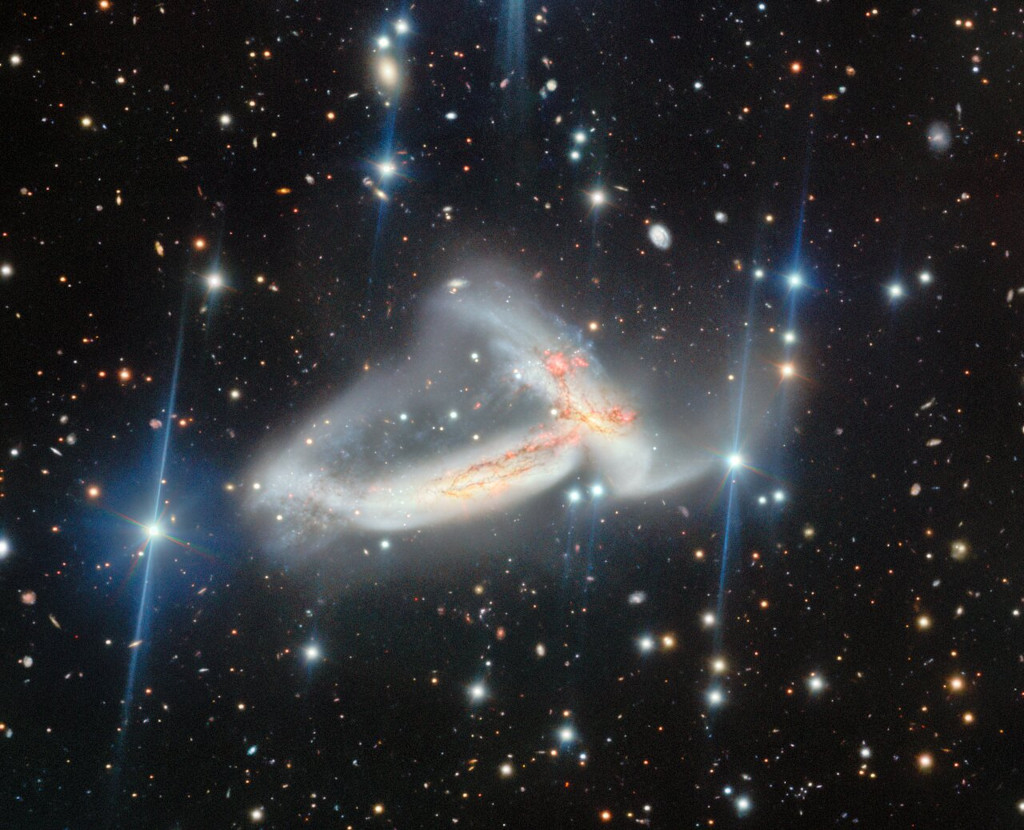
Nā ʻUhane Māhoe Huki Pū i ke Ola
Nā ʻUhane Māhoe Huki Pū i ke Ola, is the Hawaiian name given to this image of a pair of spiral galaxies locked in a mutual gravitational embrace. Some 200 million light-years distant toward the high flying constellation Pegasus their spectacular, galactic scale merger is captured in sharp detail in the image from the 8.1 meter Gemini North telescope on Maunakea, Hawai‘i. The galaxy pair, known as NGC 7253 and Arp 278, was chosen as a target, researched, and given a Hawaiian name by high school students in the joint Gemini Observatory and University of Hawaiʻi Project Hōkūlani internship program. The name translates to "The Twin Spirits Pulling Together Creating Life". That's both culturally and astronomically appropriate for galaxy collisions that trigger a cosmic maelstrom of star formation from galactic reservoirs of elemental building blocks of life. These merging galaxies are found within a region of Pegasus identified as the Hawaiian navigational constellation Ka Lupe o Kawelo. APOD's main NASA site is moving: From apod.nasa.gov to science.nasa.gov/apod
A 0–9 score for how stirred up Earth’s magnetic field is, measured every 3 hours by magnetometers around the world. 0–2 is quiet, 3–4 is unsettled, and 5 or more is a geomagnetic storm. The higher it goes, the farther from the poles the northern lights reach. Around Kp 5, people in Washington State can sometimes see them low in the north.
- Kp 5 G1 minor
- Kp 6 G2 moderate
- Kp 7 G3 strong
- Kp 8 G4 severe
- Kp 9 G5 extreme
A rough guide based only on the current Kp: Unlikely below 4, Possible at 4–5, Likely at 6–7, Strong at 8+. It isn’t for your exact location, so use “Your sky this week” for odds where you are. Clouds and city lights matter too.
Learn more at NOAA SWPCA stream of charged particles flowing from the Sun, measured by spacecraft about 1.5 million km (1 million miles) toward the Sun from Earth. It usually blows at 300–500 km/s. Faster than about 600 km/s often means stormier space weather, and whatever is measured now reaches Earth roughly 30–60 minutes later.
Learn more at NOAA SWPC