Past Forecasts
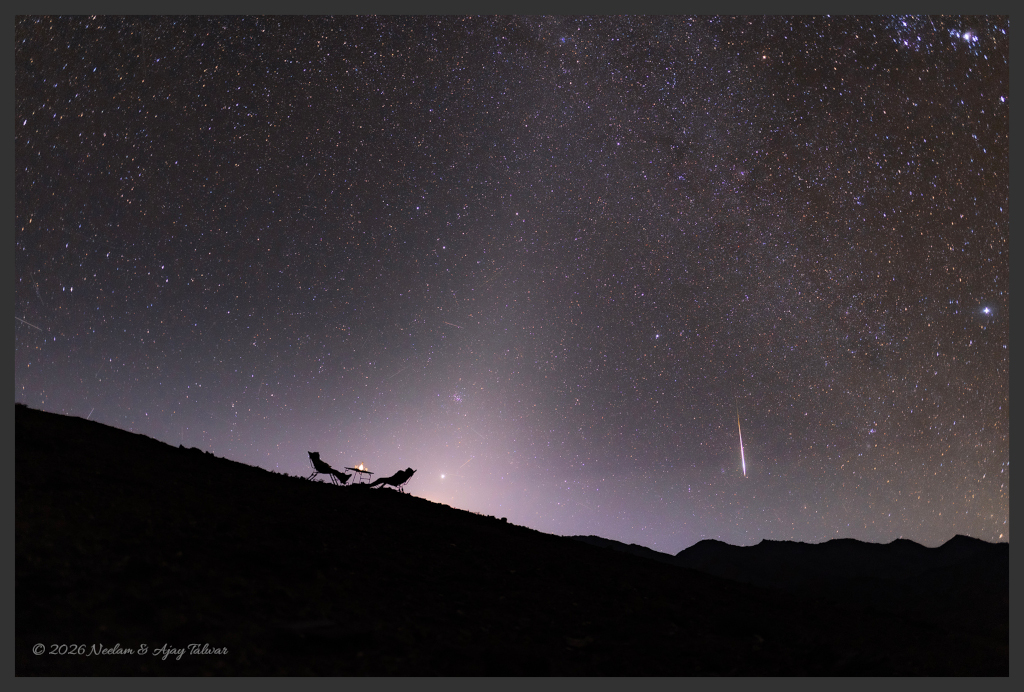
A Zodiacal Night
Also known as the false dawn, a luminous band of zodiacal light is captured in this dark night skyscape. The serene view was recorded just before the beginning of astronomical twilight during September's star party at the remote Hanle Dark Sky Reserve, Ladakh, India, planet Earth. At about 4,500 meters altitude, the dark sky reserve presents a haven for hardy stargazing and astrophotography enthusiasts. While meteors streak through the night, bright planet Jupiter appears immersed in the faint zodiacal glow near the eastern horizon. Follow the zodiacal band toward the zenith to find open star cluster M44 and a yellowish tinged planet Mars near the center of the frame. In fact, serendipitous detections of interplanetary dust by NASA's Juno spacecraft suggest Mars itself is the source of dust that back scatters sunlight and creates zodiacal light in planet Earth's night. APOD's main NASA site is moving: From apod.nasa.gov to science.nasa.gov/apod
Credit & Copyright: Neelam and Ajay Talwar
A 0–9 score for how stirred up Earth’s magnetic field is, measured every 3 hours by magnetometers around the world. 0–2 is quiet, 3–4 is unsettled, and 5 or more is a geomagnetic storm. The higher it goes, the farther from the poles the northern lights reach. Around Kp 5, people in Washington State can sometimes see them low in the north.
- Kp 5 G1 minor
- Kp 6 G2 moderate
- Kp 7 G3 strong
- Kp 8 G4 severe
- Kp 9 G5 extreme
A rough guide based only on the current Kp: Unlikely below 4, Possible at 4–5, Likely at 6–7, Strong at 8+. It isn’t for your exact location, so use “Your sky this week” for odds where you are. Clouds and city lights matter too.
Learn more at NOAA SWPCA stream of charged particles flowing from the Sun, measured by spacecraft about 1.5 million km (1 million miles) toward the Sun from Earth. It usually blows at 300–500 km/s. Faster than about 600 km/s often means stormier space weather, and whatever is measured now reaches Earth roughly 30–60 minutes later.
Learn more at NOAA SWPC