Past Forecasts
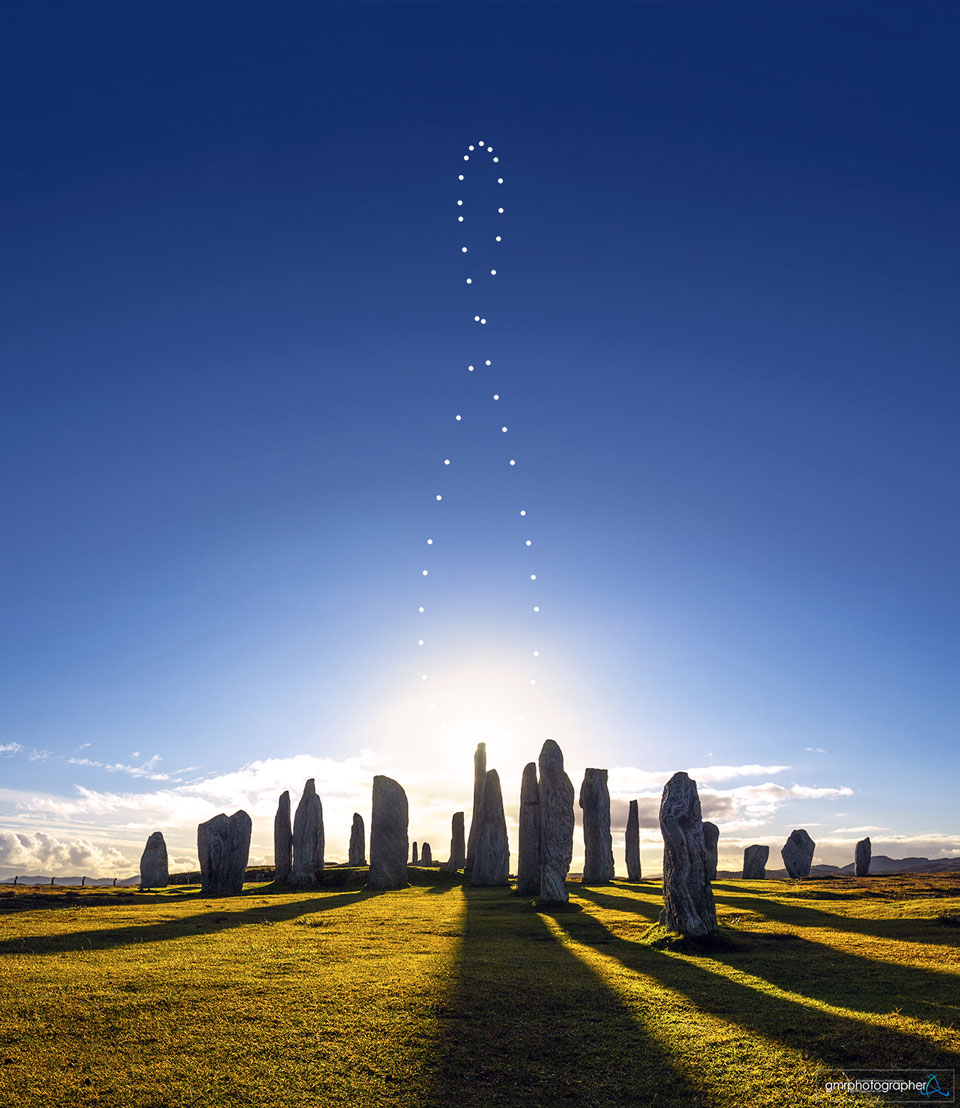
Analemma over the Callanish Stones
If you went outside at the same time every day and took a picture that included the Sun, how would the Sun's position change? A visual answer to that question is an analemma, a composite image taken from the same spot at the same time over the course of a year. The featured analemma was composed from images taken every few days at noon near the village of Callanish in the Outer Hebrides in Scotland, UK. In the foreground are the Callanish Stones, a stone circle built around 2700 BC during humanity's Bronze Age. It is not known if the placement of the Callanish Stones has or had astronomical significance. The ultimate causes for the figure-8 shape of this and all analemmas are the tilt of the Earth axis and the ellipticity of the Earth's orbit around the Sun. At the solstices, the Sun will appear at the top or bottom of an analemma. The featured image was taken near the December solstice and so the Sun appears near the bottom. Equinoxes, however, correspond to analemma middle points -- not the intersection point. In two days there will be an equinox ("equal night"), when day and night are equal over all of planet Earth. Many cultures celebrate a change of season at an equinox. APOD's main NASA site is moving: From apod.nasa.gov to science.nasa.gov/apod
Credit & Copyright: Giuseppe Petricca
A 0–9 score for how stirred up Earth’s magnetic field is, measured every 3 hours by magnetometers around the world. 0–2 is quiet, 3–4 is unsettled, and 5 or more is a geomagnetic storm. The higher it goes, the farther from the poles the northern lights reach. Around Kp 5, people in Washington State can sometimes see them low in the north.
- Kp 5 G1 minor
- Kp 6 G2 moderate
- Kp 7 G3 strong
- Kp 8 G4 severe
- Kp 9 G5 extreme
A rough guide based only on the current Kp: Unlikely below 4, Possible at 4–5, Likely at 6–7, Strong at 8+. It isn’t for your exact location, so use “Your sky this week” for odds where you are. Clouds and city lights matter too.
Learn more at NOAA SWPCA stream of charged particles flowing from the Sun, measured by spacecraft about 1.5 million km (1 million miles) toward the Sun from Earth. It usually blows at 300–500 km/s. Faster than about 600 km/s often means stormier space weather, and whatever is measured now reaches Earth roughly 30–60 minutes later.
Learn more at NOAA SWPC