Past Forecasts
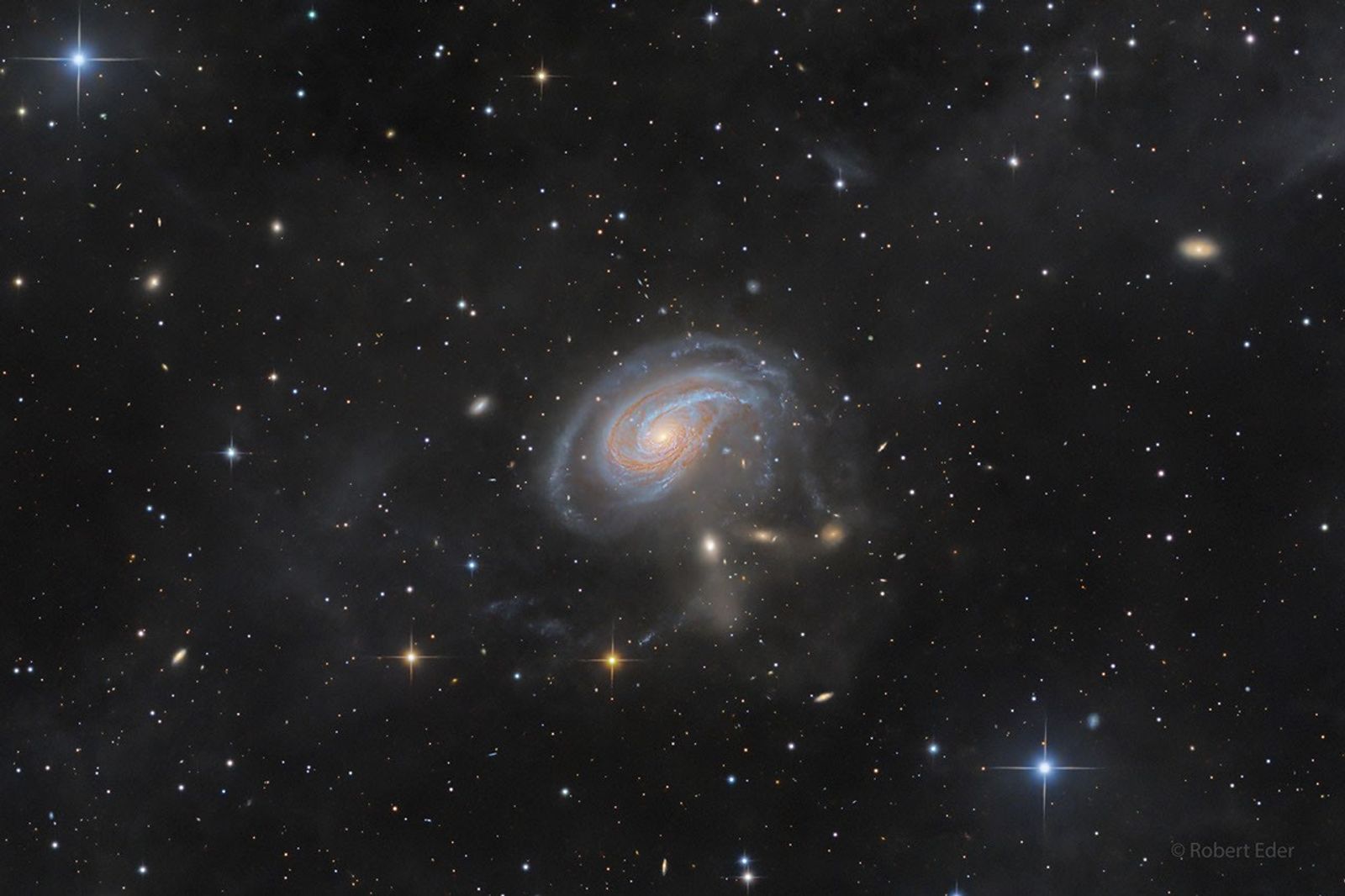
Arp 78: Peculiar Galaxy in Aries
Explanation: Peculiar spiral galaxy Arp 78 is found within the boundaries of the head strong constellation Aries. Some 100 million light-years beyond the stars and nebulae of our Milky Way galaxy, the island universe is an enormous 200,000 light-years across. Also known as NGC 772, it sports a prominent, outer spiral arm in this detailed cosmic portrait. Tracking along sweeping dust lanes and lined with young blue star clusters, Arp 78's overdeveloped spiral arm is pumped-up by galactic-scale gravitational tides. Interactions with its brightest companion galaxy, the more compact NGC 770 seen directly below the larger spiral, are likely responsible. Embedded in faint star streams revealed in the deep telescopic exposure, NGC 770's fuzzy, elliptical appearance contrasts nicely with spiky foreground Milky Way stars. APOD's email for image submissions has changed. Please see: APOD Submissions. Tomorrow's picture: a harvest
Credit & Copyright: Robert Eder
A 0–9 score for how stirred up Earth’s magnetic field is, measured every 3 hours by magnetometers around the world. 0–2 is quiet, 3–4 is unsettled, and 5 or more is a geomagnetic storm. The higher it goes, the farther from the poles the northern lights reach. Around Kp 5, people in Washington State can sometimes see them low in the north.
- Kp 5 G1 minor
- Kp 6 G2 moderate
- Kp 7 G3 strong
- Kp 8 G4 severe
- Kp 9 G5 extreme
A rough guide based only on the current Kp: Unlikely below 4, Possible at 4–5, Likely at 6–7, Strong at 8+. It isn’t for your exact location, so use “Your sky this week” for odds where you are. Clouds and city lights matter too.
Learn more at NOAA SWPCA stream of charged particles flowing from the Sun, measured by spacecraft about 1.5 million km (1 million miles) toward the Sun from Earth. It usually blows at 300–500 km/s. Faster than about 600 km/s often means stormier space weather, and whatever is measured now reaches Earth roughly 30–60 minutes later.
Learn more at NOAA SWPC