Past Forecasts
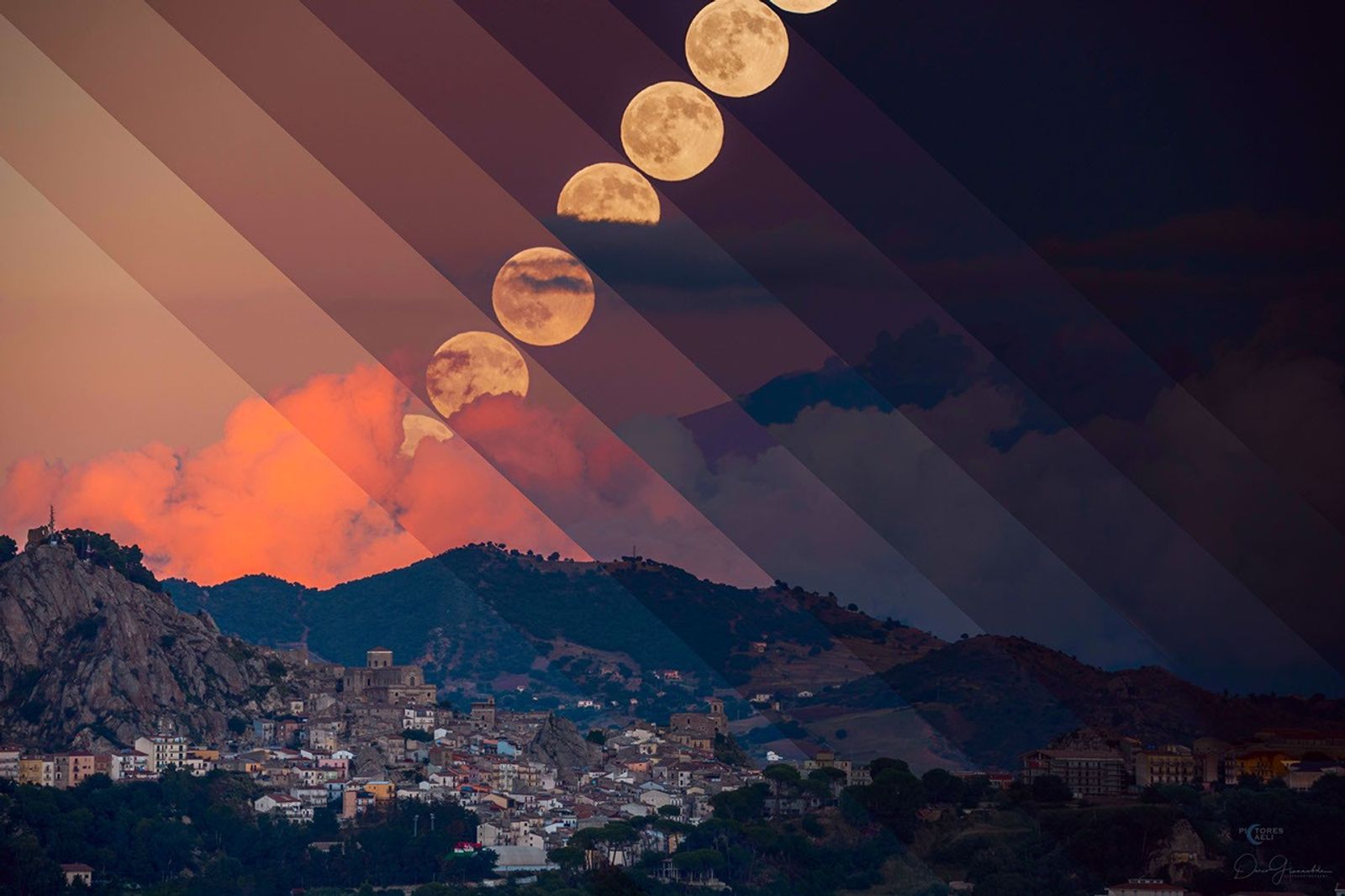
Harvest Moon with Erupting Mount Etna
Explanation: Have you ever seen the full moon rise? This colorful image was photographed last weekend in Sicily, just outside the town of Nicosia, in Italy. It is a composite photograph that shows the Moon rising as the sky turns darker. Lower clouds are reflecting the colors of antitwilight, while ash and gas from Mount Etna are seen higher in the background. The pink band lower in the sky is called the Belt of Venus. During a full moon, the Moon and the Sun are in opposition in the sky: the moon rises as the sun sets. The lunar phase cycle lasts approximately 29.5 days (but the Moon takes approximately 27 days to orbit the Earth). In some cultures of the Northern Hemisphere, the September full moon is called the Harvest Moon. Does your culture have a special name for it? (A full moon by any other name would shine as bright.) APOD's email for image submissions has changed. Please see: APOD Submissions APOD's main NASA site has moved : From apod.nasa.gov to science.nasa.gov/apod Tomorrow's picture: sharpless
Credit & Copyright: Dario Giannobile
A 0–9 score for how stirred up Earth’s magnetic field is, measured every 3 hours by magnetometers around the world. 0–2 is quiet, 3–4 is unsettled, and 5 or more is a geomagnetic storm. The higher it goes, the farther from the poles the northern lights reach. Around Kp 5, people in Washington State can sometimes see them low in the north.
- Kp 5 G1 minor
- Kp 6 G2 moderate
- Kp 7 G3 strong
- Kp 8 G4 severe
- Kp 9 G5 extreme
A rough guide based only on the current Kp: Unlikely below 4, Possible at 4–5, Likely at 6–7, Strong at 8+. It isn’t for your exact location, so use “Your sky this week” for odds where you are. Clouds and city lights matter too.
Learn more at NOAA SWPCA stream of charged particles flowing from the Sun, measured by spacecraft about 1.5 million km (1 million miles) toward the Sun from Earth. It usually blows at 300–500 km/s. Faster than about 600 km/s often means stormier space weather, and whatever is measured now reaches Earth roughly 30–60 minutes later.
Learn more at NOAA SWPC