Past Forecasts
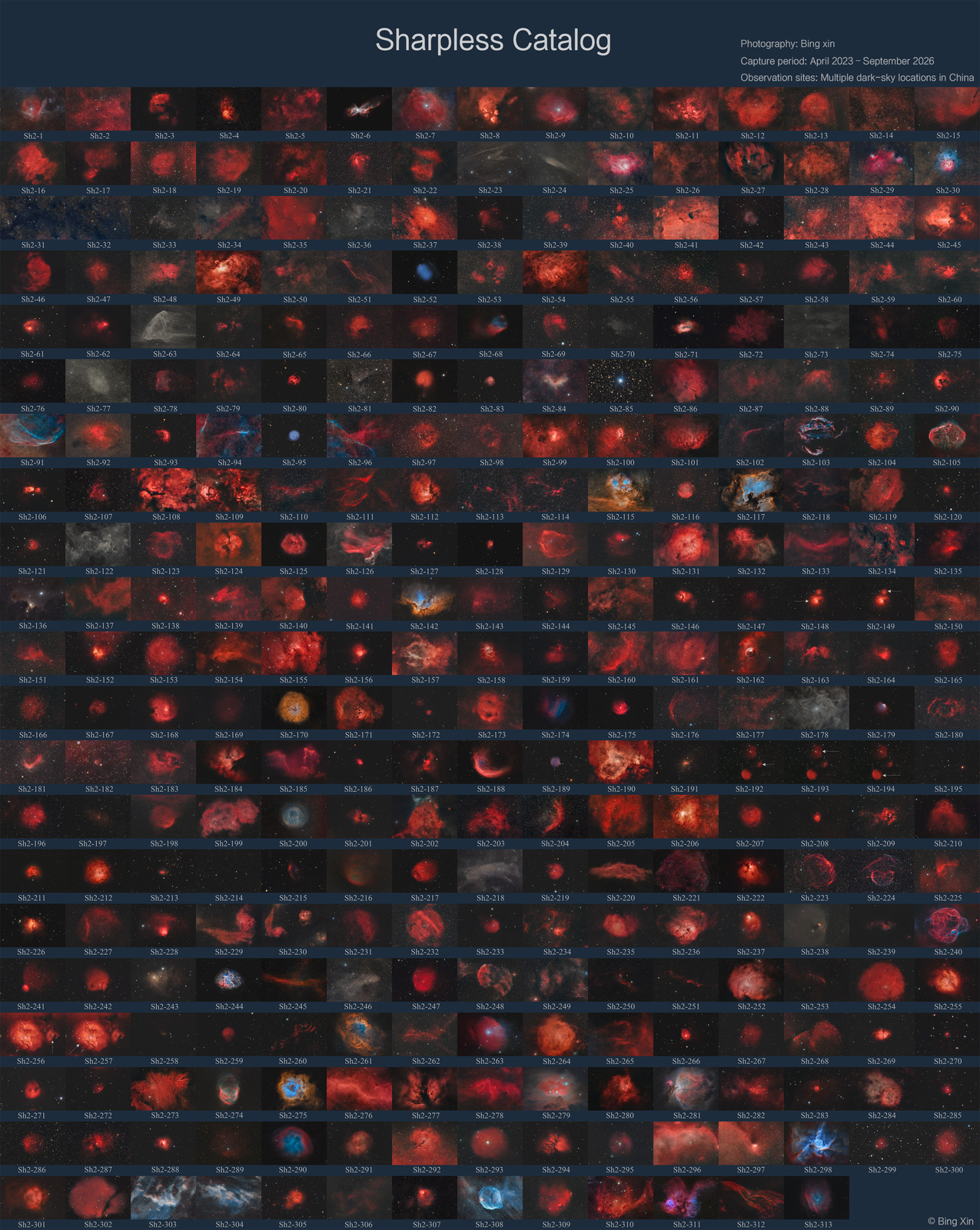
The Complete Sharpless Catalog: 313 Nebulas
Explanation: What does it take to image hundreds of nebulas? Today’s image contains the entire Sharpless Catalog of H II Regions, totaling 313 objects. Zoom in and explore! You may spot fan favorites like the Eagle (Sh2-49), Heart (Sh2-190), and Orion (Sh2-281) Nebulas. Despite its name, this catalog contains more than the glow of ionized hydrogen that makes up H II regions. There are planetary nebulas (the Medusa Nebula, Sh2-274) and supernova remnants (the Spaghetti Nebula, Sh2-240) as well. Astrophotographer Bing Xin traversed the dark skies of Eastern China and Inner Mongolia to catch them all. Narrowband filters that primarily capture light from ionized hydrogen and oxygen as well as red-green-blue filters were used. Each object took 2 to 6 hours to capture, with the entire catalog taking around 800 hours to complete! Which object is your favorite? APOD's email for image submissions has changed. Please see: APOD Submissions Tomorrow's picture: just Curiosity
Credit & Copyright: Bing Xin
A 0–9 score for how stirred up Earth’s magnetic field is, measured every 3 hours by magnetometers around the world. 0–2 is quiet, 3–4 is unsettled, and 5 or more is a geomagnetic storm. The higher it goes, the farther from the poles the northern lights reach. Around Kp 5, people in Washington State can sometimes see them low in the north.
- Kp 5 G1 minor
- Kp 6 G2 moderate
- Kp 7 G3 strong
- Kp 8 G4 severe
- Kp 9 G5 extreme
A rough guide based only on the current Kp: Unlikely below 4, Possible at 4–5, Likely at 6–7, Strong at 8+. It isn’t for your exact location, so use “Your sky this week” for odds where you are. Clouds and city lights matter too.
Learn more at NOAA SWPCA stream of charged particles flowing from the Sun, measured by spacecraft about 1.5 million km (1 million miles) toward the Sun from Earth. It usually blows at 300–500 km/s. Faster than about 600 km/s often means stormier space weather, and whatever is measured now reaches Earth roughly 30–60 minutes later.
Learn more at NOAA SWPC