Past Forecasts
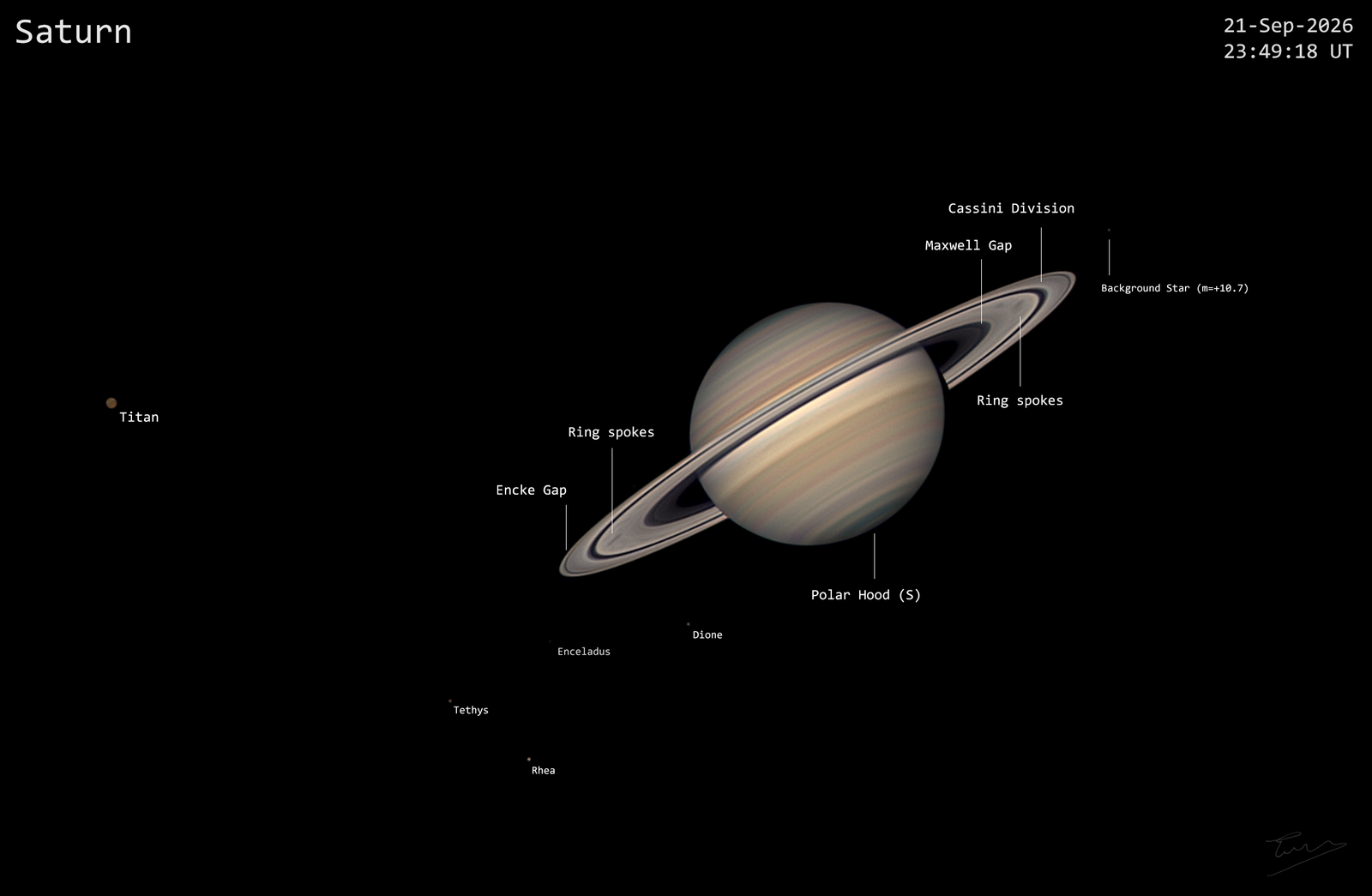
The Saturn System Smörgåsbord
Explanation: How was the Saturn system imaged so clearly? Astrophotographer Tom Williams captured such exquisite details due to one night of exceptional atmospheric conditions above the United Kingdom. This means more than a cloudless sky. Pockets of air at different temperatures and densities move around and bend light as it travels through Earth’s atmosphere, distorting astronomy images. This is called “seeing.” Less atmospheric turbulence means clearer images. The astrophotographer reduced the impact of seeing with the lucky imaging technique: thousands of short-exposure images are taken very quickly with a high-speed camera and the clearest images are added up. Which object in this smörgåsbord interests you? Perhaps Titan or the icy stripes of Enceladus? Maybe the gaps and spokes in Saturn’s rings? Saturn's opposition, when Earth passes in between the planet and the Sun, occurred on October 4th. Due to the planet's proximity and full illumination from the Sun, now is a great time of year to observe it! Tomorrow's picture: bumpy
Credit & Copyright: Tom Williams
A 0–9 score for how stirred up Earth’s magnetic field is, measured every 3 hours by magnetometers around the world. 0–2 is quiet, 3–4 is unsettled, and 5 or more is a geomagnetic storm. The higher it goes, the farther from the poles the northern lights reach. Around Kp 5, people in Washington State can sometimes see them low in the north.
- Kp 5 G1 minor
- Kp 6 G2 moderate
- Kp 7 G3 strong
- Kp 8 G4 severe
- Kp 9 G5 extreme
A rough guide based only on the current Kp: Unlikely below 4, Possible at 4–5, Likely at 6–7, Strong at 8+. It isn’t for your exact location, so use “Your sky this week” for odds where you are. Clouds and city lights matter too.
Learn more at NOAA SWPCA stream of charged particles flowing from the Sun, measured by spacecraft about 1.5 million km (1 million miles) toward the Sun from Earth. It usually blows at 300–500 km/s. Faster than about 600 km/s often means stormier space weather, and whatever is measured now reaches Earth roughly 30–60 minutes later.
Learn more at NOAA SWPCISS · 3
-
 Anil Menon
NASA
-
 Anna Kikina
Roscosmos
-
Pyotr Dubrov
Roscosmos
Tiangong · 3
-
 Lai Ka-ying
CNSA
-
Zhang Zhiyuan
CNSA
-
Zhu Yangzhu
CNSA
In orbit · 4
-
Jessica Watkins
NASA
-
 Joshua Kutryk
CSA
-
Luke Delaney
NASA
-
Sergey Teteryatnikov
Roscosmos