Past Forecasts
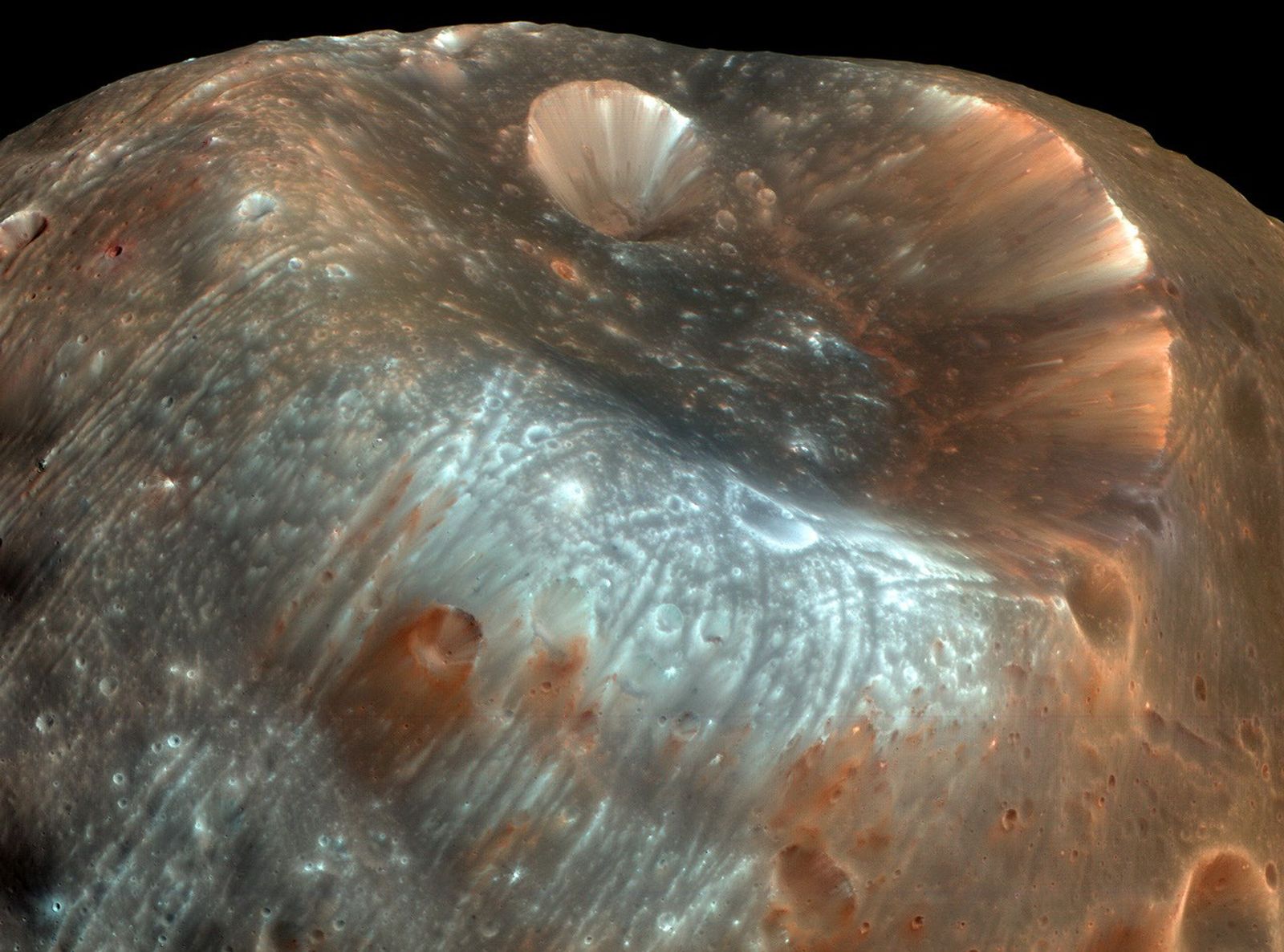
Stickney Crater
Explanation: Stickney Crater, the largest crater on the martian moon Phobos, is named for Chloe Angeline Stickney Hall, mathematician and wife of astronomer Asaph Hall. Asaph Hall discovered both the Red Planet's moons in 1877. Over 9 kilometers across, Stickney is nearly half the diameter of Phobos itself, so large that the impact that blasted out the crater likely came close to shattering the tiny moon. This enhanced-color image of Stickney and surroundings was recorded by the HiRISE camera onboard the Mars Reconnaissance Orbiter as it passed within some six thousand kilometers of Phobos in March of 2008. Even though the surface gravity of asteroid-like Phobos is less than 1/1000th Earth's gravity, streaks suggest loose material slid down inside the crater walls over time. Light bluish regions near the crater's rim could indicate a relatively freshly exposed surface. The origin of the curious grooves along the surface is mysterious but may be related to tidal stresses experienced by close-orbiting Phobos or the crater-forming impact itself. Tomorrow's picture: farside
Credit & Copyright: HiRISE, MRO, LPL (U. Arizona), NASA
A 0–9 score for how stirred up Earth’s magnetic field is, measured every 3 hours by magnetometers around the world. 0–2 is quiet, 3–4 is unsettled, and 5 or more is a geomagnetic storm. The higher it goes, the farther from the poles the northern lights reach. Around Kp 5, people in Washington State can sometimes see them low in the north.
- Kp 5 G1 minor
- Kp 6 G2 moderate
- Kp 7 G3 strong
- Kp 8 G4 severe
- Kp 9 G5 extreme
A rough guide based only on the current Kp: Unlikely below 4, Possible at 4–5, Likely at 6–7, Strong at 8+. It isn’t for your exact location, so use “Your sky this week” for odds where you are. Clouds and city lights matter too.
Learn more at NOAA SWPCA stream of charged particles flowing from the Sun, measured by spacecraft about 1.5 million km (1 million miles) toward the Sun from Earth. It usually blows at 300–500 km/s. Faster than about 600 km/s often means stormier space weather, and whatever is measured now reaches Earth roughly 30–60 minutes later.
Learn more at NOAA SWPCISS · 7
-
 Anil Menon
NASA
-
 Anna Kikina
Roscosmos
-
Jessica Watkins
NASA
-
 Joshua Kutryk
CSA
-
Luke Delaney
NASA
-
Pyotr Dubrov
Roscosmos
-
Sergey Teteryatnikov
Roscosmos
Tiangong · 3
-
 Lai Ka-ying
CNSA
-
Zhang Zhiyuan
CNSA
-
Zhu Yangzhu
CNSA