Past Forecasts
A Year of Sunspots
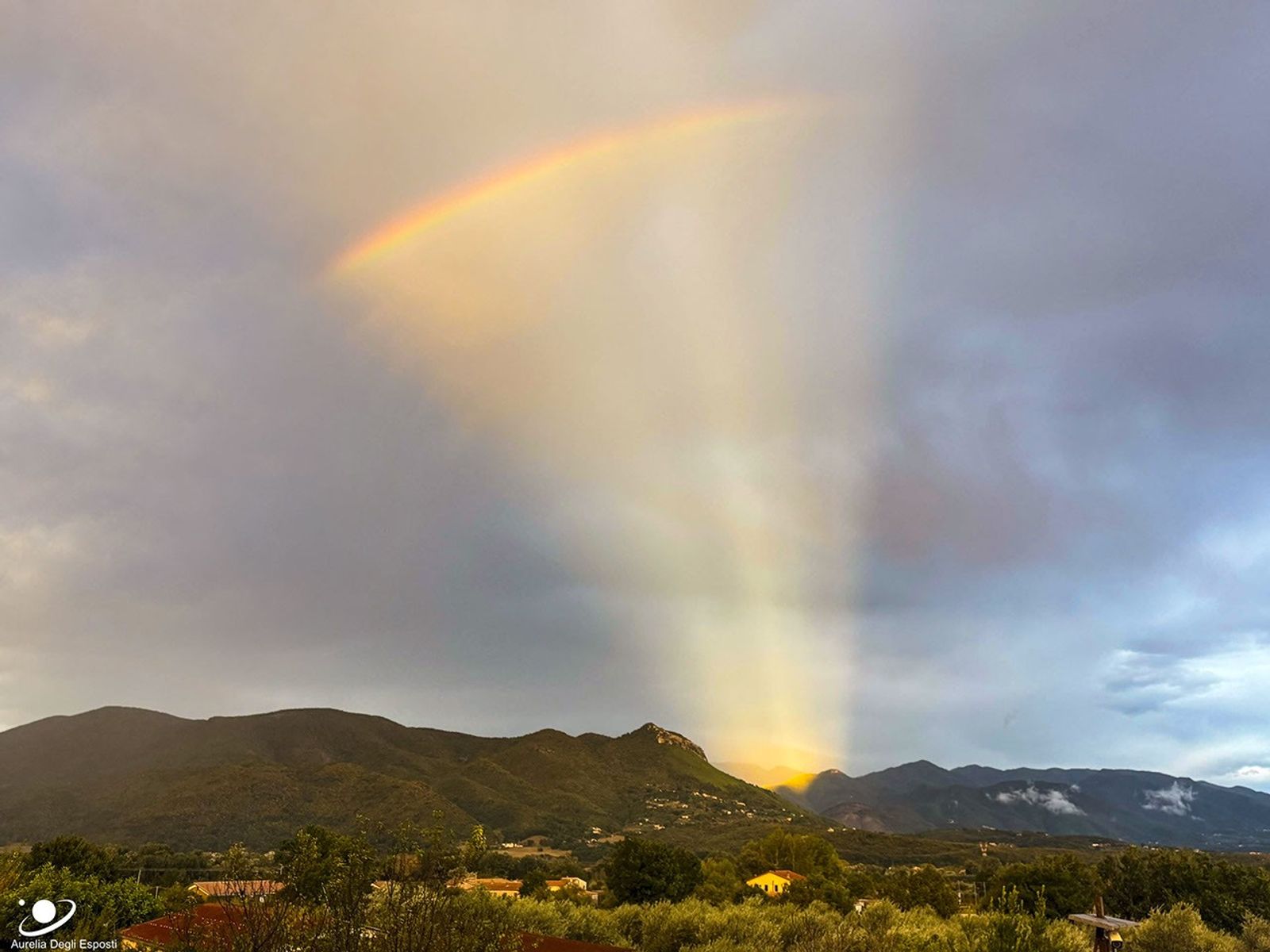
Explanation: This is an unusual rainbow. For one thing, the rainbow is not complete, appearing only in a sunlit fan -- but that by itself is not very unusual. What is most unusual is the fake location of the Sun. The Sun appears to be toward the front, just below those hills -- but it is not. That is not how rainbows work. Rainbows involve a backward reflection from falling rain, so that the Sun must really be behind you. In this case, gaps between clouds near the setting Sun allowed rays to cross the entire sky and appear to converge in front, an unusual phenomenon called anticrepuscular rays. The photo was taken with a phone last week at sunset in Presenzano, Italy. The seemingly reverse rainbow was noticed when hanging up laundry. Tomorrow's picture: open space
Credit & Copyright: Aurelia Degli Esposti
A 0–9 score for how stirred up Earth’s magnetic field is, measured every 3 hours by magnetometers around the world. 0–2 is quiet, 3–4 is unsettled, and 5 or more is a geomagnetic storm. The higher it goes, the farther from the poles the northern lights reach. Around Kp 5, people in Washington State can sometimes see them low in the north.
- Kp 5 G1 minor
- Kp 6 G2 moderate
- Kp 7 G3 strong
- Kp 8 G4 severe
- Kp 9 G5 extreme
A rough guide based only on the current Kp: Unlikely below 4, Possible at 4–5, Likely at 6–7, Strong at 8+. It isn’t for your exact location, so use “Your sky this week” for odds where you are. Clouds and city lights matter too.
Learn more at NOAA SWPCA stream of charged particles flowing from the Sun, measured by spacecraft about 1.5 million km (1 million miles) toward the Sun from Earth. It usually blows at 300–500 km/s. Faster than about 600 km/s often means stormier space weather, and whatever is measured now reaches Earth roughly 30–60 minutes later.
Learn more at NOAA SWPCISS · 7
-
 Anil Menon
NASA
-
 Anna Kikina
Roscosmos
-
Jessica Watkins
NASA
-
 Joshua Kutryk
CSA
-
Luke Delaney
NASA
-
Pyotr Dubrov
Roscosmos
-
Sergey Teteryatnikov
Roscosmos
Tiangong · 3
-
 Lai Ka-ying
CNSA
-
Zhang Zhiyuan
CNSA
-
Zhu Yangzhu
CNSA