Past Forecasts
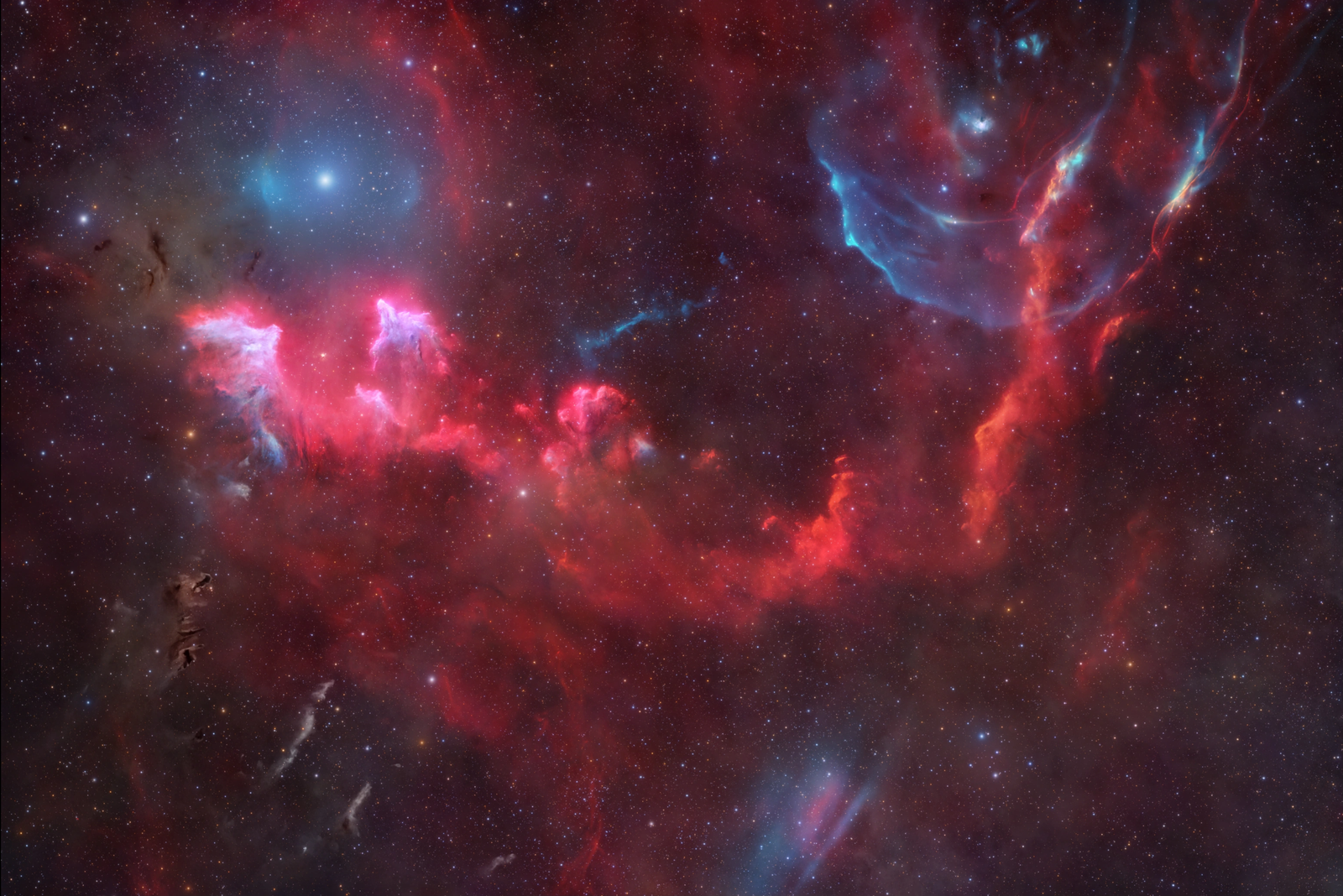
New Ghosts Revealed in Cassiopeia
Explanation: Jinkies, look at all those ghosts! It took 100 hours of observation and a special oxygen filter for today’s image to capture three faint nebulas hidden in the Cassiopeia constellation. IC 59 and IC 63, the original Ghosts of Cassiopeia, haunt the region near multi-star system γ Cassiopeia. Energetic light from γ Cassiopeia causes the hydrogen gas in IC 59 and 63 to glow red. Their dust reflects and scatters some blue-ish white starlight. Newly discovered Objects 1, 2, and 3 appear as blue phantoms, revealing the presence of ionized oxygen. But ionized by what? Like at the bow of a speeding boat, γ Cassiopeia may be piling up material as the system moves through interstellar gas and dust. It follows that Object 3 may be the compressed and heated oxygen of that bow shock. Object 1 could be a planetary nebula if a central white dwarf is identified. The origins of these astronomical apparitions remain a mystery to be solved. Read here for more information on how you can help the observing team behind today's APOD. Tomorrow's picture: it's not easy being green
Credit & Copyright: Louis Leroux-Géré, Thibault Rouillée, Vincent Martin, Cédric de Decker (Starfront Observatories)
A 0–9 score for how stirred up Earth’s magnetic field is, measured every 3 hours by magnetometers around the world. 0–2 is quiet, 3–4 is unsettled, and 5 or more is a geomagnetic storm. The higher it goes, the farther from the poles the northern lights reach. Around Kp 5, people in Washington State can sometimes see them low in the north.
- Kp 5 G1 minor
- Kp 6 G2 moderate
- Kp 7 G3 strong
- Kp 8 G4 severe
- Kp 9 G5 extreme
A rough guide based only on the current Kp: Unlikely below 4, Possible at 4–5, Likely at 6–7, Strong at 8+. It isn’t for your exact location, so use “Your sky this week” for odds where you are. Clouds and city lights matter too.
Learn more at NOAA SWPCA stream of charged particles flowing from the Sun, measured by spacecraft about 1.5 million km (1 million miles) toward the Sun from Earth. It usually blows at 300–500 km/s. Faster than about 600 km/s often means stormier space weather, and whatever is measured now reaches Earth roughly 30–60 minutes later.
Learn more at NOAA SWPCISS · 7
-
 Anil Menon
NASA
-
 Anna Kikina
Roscosmos
-
Jessica Watkins
NASA
-
 Joshua Kutryk
CSA
-
Luke Delaney
NASA
-
Pyotr Dubrov
Roscosmos
-
Sergey Teteryatnikov
Roscosmos
Tiangong · 3
-
 Lai Ka-ying
CNSA
-
Zhang Zhiyuan
CNSA
-
Zhu Yangzhu
CNSA