Past Forecasts
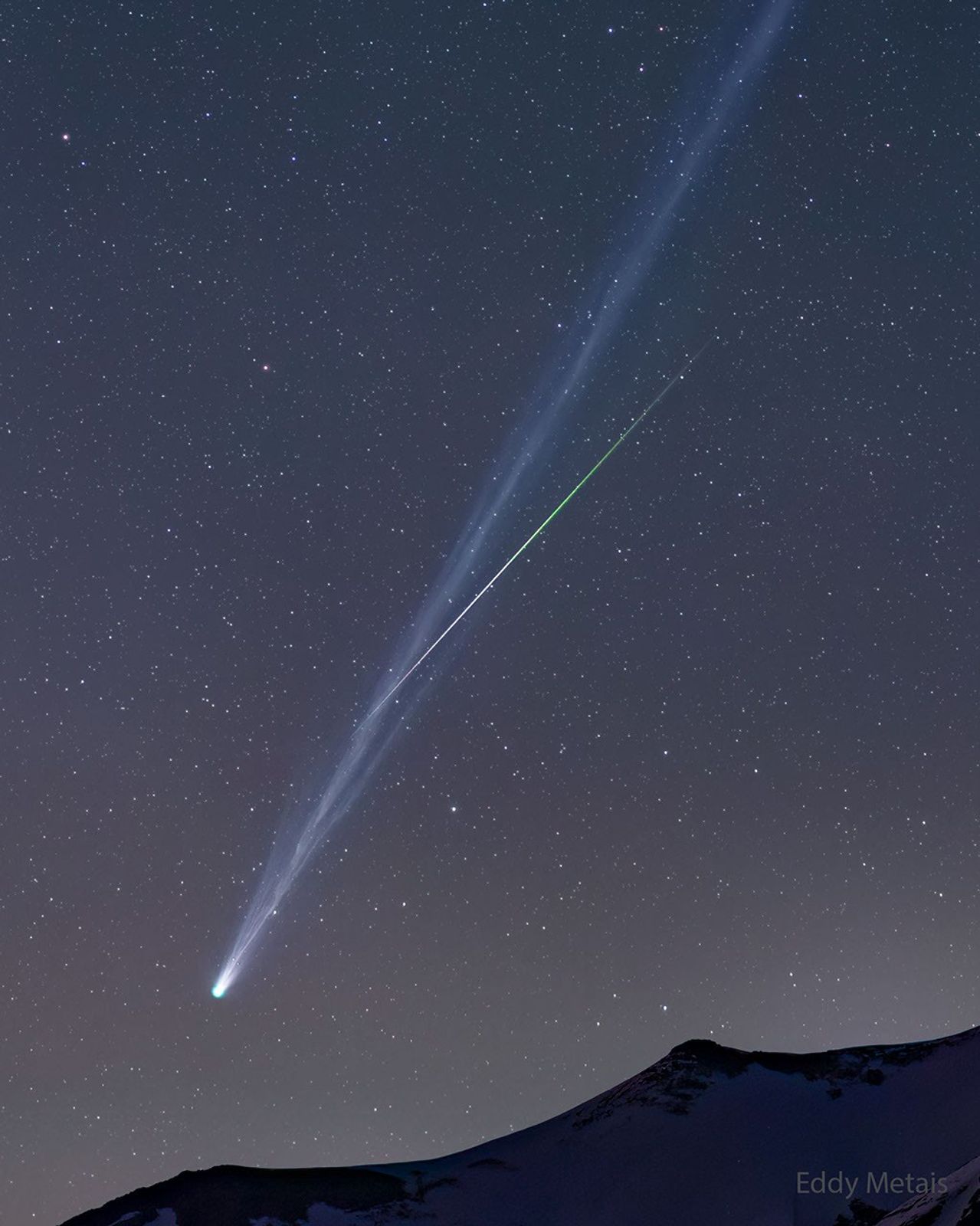
Comet PanSTARRs and Rainbow Meteor
Explanation: Did this meteor come from that comet? Probably not. Although many meteors do originate from comets, there are thousands of comets that have visited the inner Solar System recently, and matching meteors to them can be tricky. And to be clear, the pictured comet is far behind the streaking meteor. Comet C/2025 R3 (PanSTARRS) was captured from Hautacam, France in April when the giant space iceberg sported impressive ion (blue) and dust tails. Sand-sized rocky debris that enters Earth’s atmosphere typically appears as meteors, while the colorful foreground streak here may indicate a complicated composition. This month three notable meteor showers will reach their peaks. Over the next few days, the Southern Taurids will be reaching their apex, while the Northern Taurids will top out about a week later. Both originate from Comet 2P/Encke. November is most famous for the Leonids Meteor Shower, though, which originates from Comet 55P/Tempel-Tuttle and will reach its crescendo in about two weeks. Tomorrow's picture: a hidden gem
Credit & Copyright: Eddy Metais
A 0–9 score for how stirred up Earth’s magnetic field is, measured every 3 hours by magnetometers around the world. 0–2 is quiet, 3–4 is unsettled, and 5 or more is a geomagnetic storm. The higher it goes, the farther from the poles the northern lights reach. Around Kp 5, people in Washington State can sometimes see them low in the north.
- Kp 5 G1 minor
- Kp 6 G2 moderate
- Kp 7 G3 strong
- Kp 8 G4 severe
- Kp 9 G5 extreme
A rough guide based only on the current Kp: Unlikely below 4, Possible at 4–5, Likely at 6–7, Strong at 8+. It isn’t for your exact location, so use “Your sky this week” for odds where you are. Clouds and city lights matter too.
Learn more at NOAA SWPCA stream of charged particles flowing from the Sun, measured by spacecraft about 1.5 million km (1 million miles) toward the Sun from Earth. It usually blows at 300–500 km/s. Faster than about 600 km/s often means stormier space weather, and whatever is measured now reaches Earth roughly 30–60 minutes later.
Learn more at NOAA SWPCISS · 7
-
 Anil Menon
NASA
-
 Anna Kikina
Roscosmos
-
Jessica Watkins
NASA
-
 Joshua Kutryk
CSA
-
Luke Delaney
NASA
-
Pyotr Dubrov
Roscosmos
-
Sergey Teteryatnikov
Roscosmos
Tiangong · 3
-
 Lai Ka-ying
CNSA
-
Zhang Zhiyuan
CNSA
-
Zhu Yangzhu
CNSA