Past Forecasts
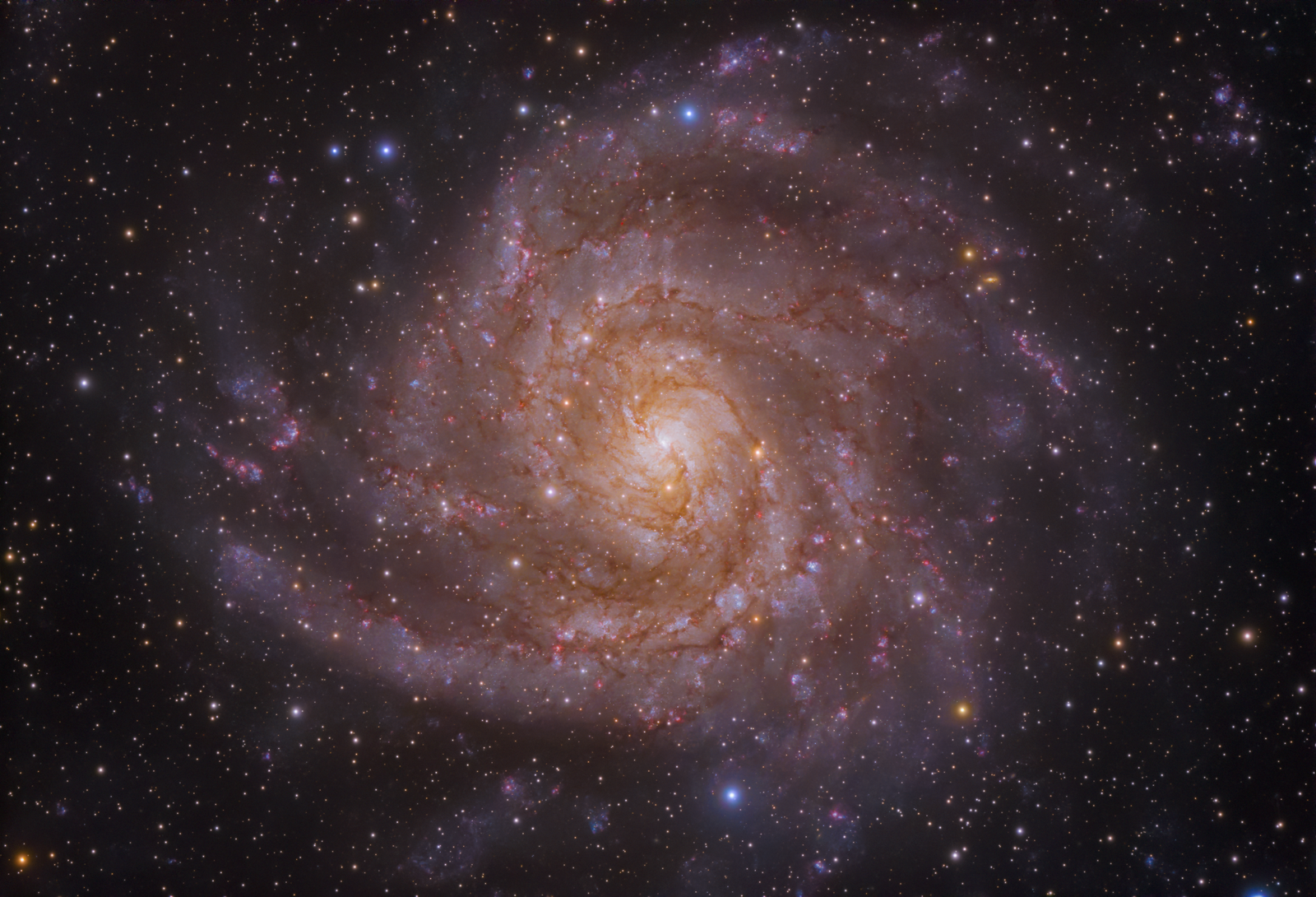
The Not-So-Hidden Galaxy, IC 342
Explanation: “I see” IC 342, the Hidden Galaxy! Today’s image peers through the plane of the Milky Way, through all its gas, dust and stars, to unveil this spiral galaxy. IC 342 (or Caldwell 5) is one of the brightest members of the IC 342/Maffei group of galaxies. Located about 10 million light years away, this group is quite close to the Local Group that includes our Milky Way. Inaccurate accounting of the crowded and dusty Milky Way foreground has led to misunderstandings in IC 342’s history, including the theory that the galaxy was ejected from the Local Group. IC 342 has its own dust intermittently blocking the glow of hydrogen gas, indicating the presence of bright, young stars. Magnetic field maps of IC 342 reveal that magnetic fields may contribute substantially to one of the biggest galactic puzzles: how do spiral arms form? Tomorrow's picture: open space
Credit & Copyright: Artem Mironov
A 0–9 score for how stirred up Earth’s magnetic field is, measured every 3 hours by magnetometers around the world. 0–2 is quiet, 3–4 is unsettled, and 5 or more is a geomagnetic storm. The higher it goes, the farther from the poles the northern lights reach. Around Kp 5, people in Washington State can sometimes see them low in the north.
- Kp 5 G1 minor
- Kp 6 G2 moderate
- Kp 7 G3 strong
- Kp 8 G4 severe
- Kp 9 G5 extreme
A rough guide based only on the current Kp: Unlikely below 4, Possible at 4–5, Likely at 6–7, Strong at 8+. It isn’t for your exact location, so use “Your sky this week” for odds where you are. Clouds and city lights matter too.
Learn more at NOAA SWPCA stream of charged particles flowing from the Sun, measured by spacecraft about 1.5 million km (1 million miles) toward the Sun from Earth. It usually blows at 300–500 km/s. Faster than about 600 km/s often means stormier space weather, and whatever is measured now reaches Earth roughly 30–60 minutes later.
Learn more at NOAA SWPCISS · 7
-
 Anil Menon
NASA
-
 Anna Kikina
Roscosmos
-
Jessica Watkins
NASA
-
 Joshua Kutryk
CSA
-
Luke Delaney
NASA
-
Pyotr Dubrov
Roscosmos
-
Sergey Teteryatnikov
Roscosmos
Tiangong · 3
-
 Lai Ka-ying
CNSA
-
Zhang Zhiyuan
CNSA
-
Zhu Yangzhu
CNSA