Past Forecasts
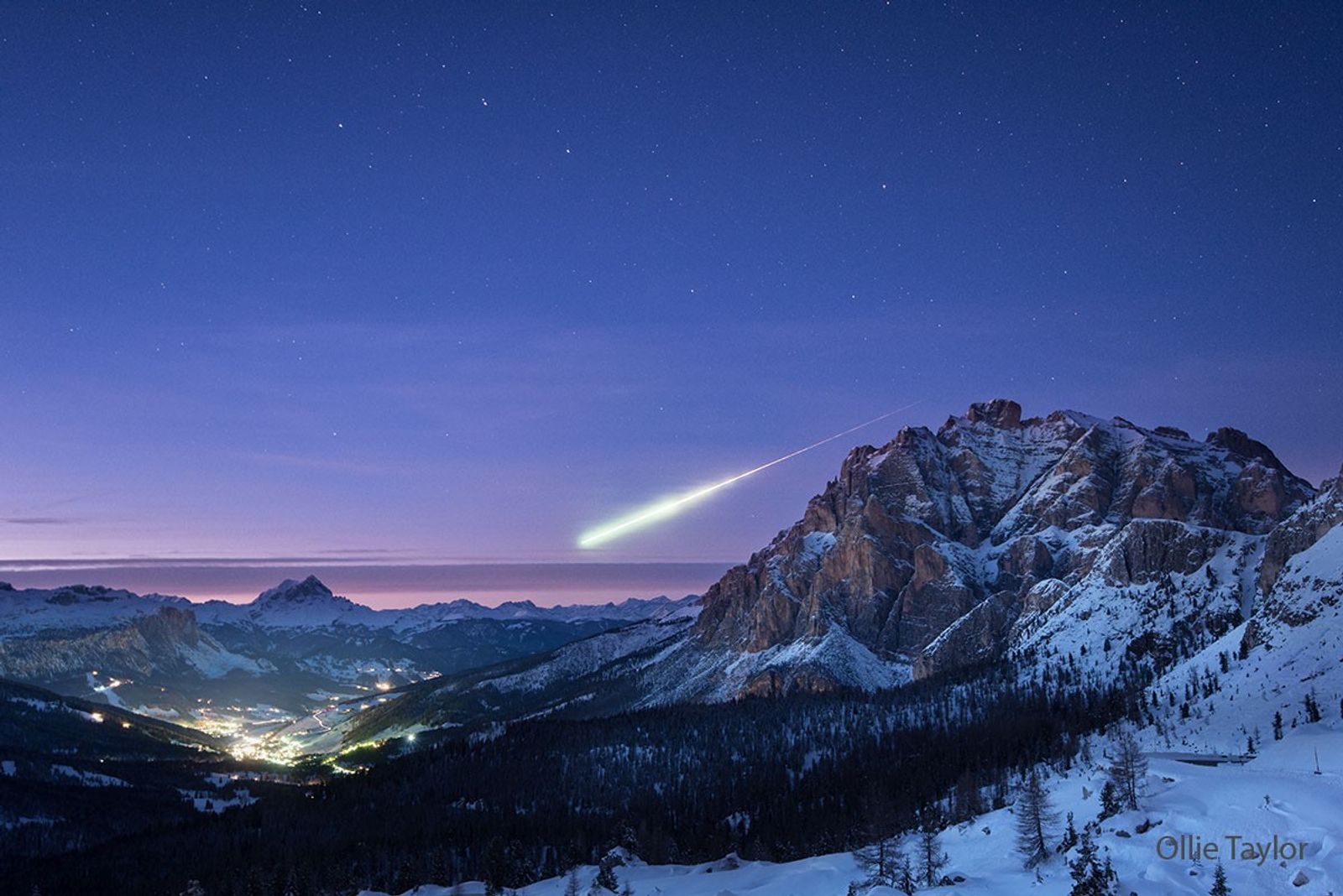
Major Fireball Meteor
Explanation: The sky glows with soft pinkish colors of fading twilight in this serendipitous mountaintop vista. Taken in subfreezing temperatures, the thoughtfully composed photo shows snowy, rugged peaks seen from a mountain pass on 2017 November 14. Below lies the village of La Villa, Alta Badia in Italy's Dolomite Alps. Above the nestled village lights, the constellation Ursa Major hangs over the northern horizon. But most stunning is the intense fireball meteor. It was captured during the camera's exposure by chance as it flashed east to west across the northern horizon, under Ursa Major's familiar Big Dipper asterism. Sightings of this major fireball meteor were widely reported in European skies, making it one of the most reported fireball events ever for planet Earth's American Meteor Society and the International Meteor Organization. The meteor's measured track over Germany is consistent with its origin near the active radiant of November's Northern Taurid Meteor Shower, a shower associated with dust from Encke's comet. Tomorrow's picture: witch sky?
Credit & Copyright: Ollie Taylor
A 0–9 score for how stirred up Earth’s magnetic field is, measured every 3 hours by magnetometers around the world. 0–2 is quiet, 3–4 is unsettled, and 5 or more is a geomagnetic storm. The higher it goes, the farther from the poles the northern lights reach. Around Kp 5, people in Washington State can sometimes see them low in the north.
- Kp 5 G1 minor
- Kp 6 G2 moderate
- Kp 7 G3 strong
- Kp 8 G4 severe
- Kp 9 G5 extreme
A rough guide based only on the current Kp: Unlikely below 4, Possible at 4–5, Likely at 6–7, Strong at 8+. It isn’t for your exact location, so use “Your sky this week” for odds where you are. Clouds and city lights matter too.
Learn more at NOAA SWPCA stream of charged particles flowing from the Sun, measured by spacecraft about 1.5 million km (1 million miles) toward the Sun from Earth. It usually blows at 300–500 km/s. Faster than about 600 km/s often means stormier space weather, and whatever is measured now reaches Earth roughly 30–60 minutes later.
Learn more at NOAA SWPCISS · 7
-
 Anil Menon
NASA
-
 Anna Kikina
Roscosmos
-
Jessica Watkins
NASA
-
 Joshua Kutryk
CSA
-
Luke Delaney
NASA
-
Pyotr Dubrov
Roscosmos
-
Sergey Teteryatnikov
Roscosmos
Tiangong · 3
-
 Lai Ka-ying
CNSA
-
Zhang Zhiyuan
CNSA
-
Zhu Yangzhu
CNSA