Past Forecasts
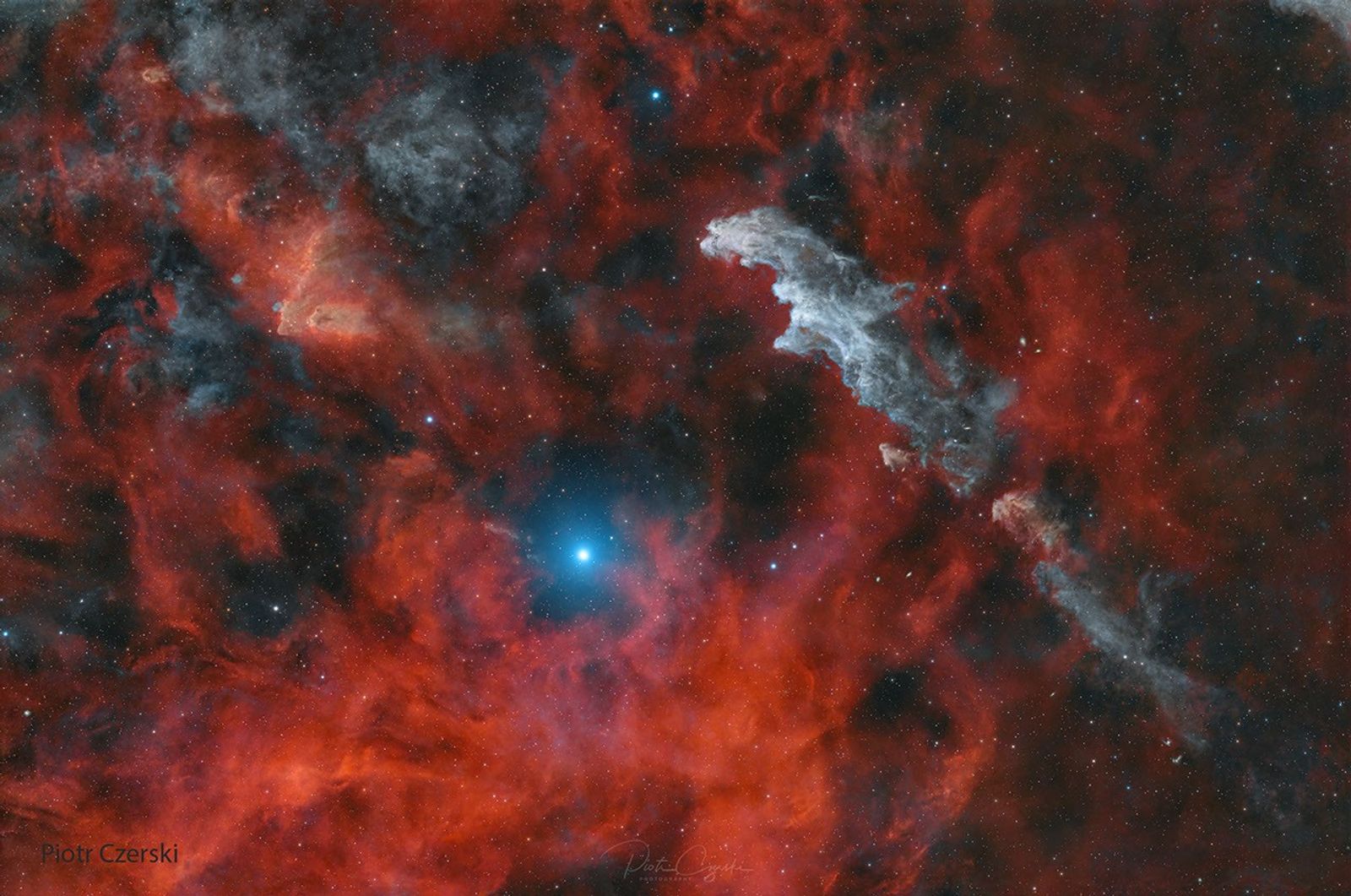
Rigel and the Witch Head Nebula
Explanation: Does the blue nebula look like the head of a witch? The nebula is known popularly as the Witch Head Nebula because, it is said, the nebula's shape resembles a Halloween-style caricature of a witch's head. Exactly how, though, can be a topic of imaginative speculation. What is clear is that IC 2118 is about 50 light-years across and made of gas and dust that points to -- because it has been partly eroded by -- the nearby star Rigel. One of the brighter stars in the constellation Orion, Rigel lies just below the center of the featured image. The blue color of the Witch Head Nebula and is caused not only by Rigel's intense blue starlight but also because the dust grains scatter blue light more efficiently than red. The same physical process causes Earth's daytime sky to appear blue, although the scatterers in planet Earth's atmosphere are molecules of nitrogen and oxygen. Tomorrow's picture: suddenly Saturn
Credit & Copyright: Piotr Czerski
A 0–9 score for how stirred up Earth’s magnetic field is, measured every 3 hours by magnetometers around the world. 0–2 is quiet, 3–4 is unsettled, and 5 or more is a geomagnetic storm. The higher it goes, the farther from the poles the northern lights reach. Around Kp 5, people in Washington State can sometimes see them low in the north.
- Kp 5 G1 minor
- Kp 6 G2 moderate
- Kp 7 G3 strong
- Kp 8 G4 severe
- Kp 9 G5 extreme
A rough guide based only on the current Kp: Unlikely below 4, Possible at 4–5, Likely at 6–7, Strong at 8+. It isn’t for your exact location, so use “Your sky this week” for odds where you are. Clouds and city lights matter too.
Learn more at NOAA SWPCA stream of charged particles flowing from the Sun, measured by spacecraft about 1.5 million km (1 million miles) toward the Sun from Earth. It usually blows at 300–500 km/s. Faster than about 600 km/s often means stormier space weather, and whatever is measured now reaches Earth roughly 30–60 minutes later.
Learn more at NOAA SWPCISS · 7
-
 Anil Menon
NASA
-
 Anna Kikina
Roscosmos
-
Jessica Watkins
NASA
-
 Joshua Kutryk
CSA
-
Luke Delaney
NASA
-
Pyotr Dubrov
Roscosmos
-
Sergey Teteryatnikov
Roscosmos
Tiangong · 3
-
 Lai Ka-ying
CNSA
-
Zhang Zhiyuan
CNSA
-
Zhu Yangzhu
CNSA